
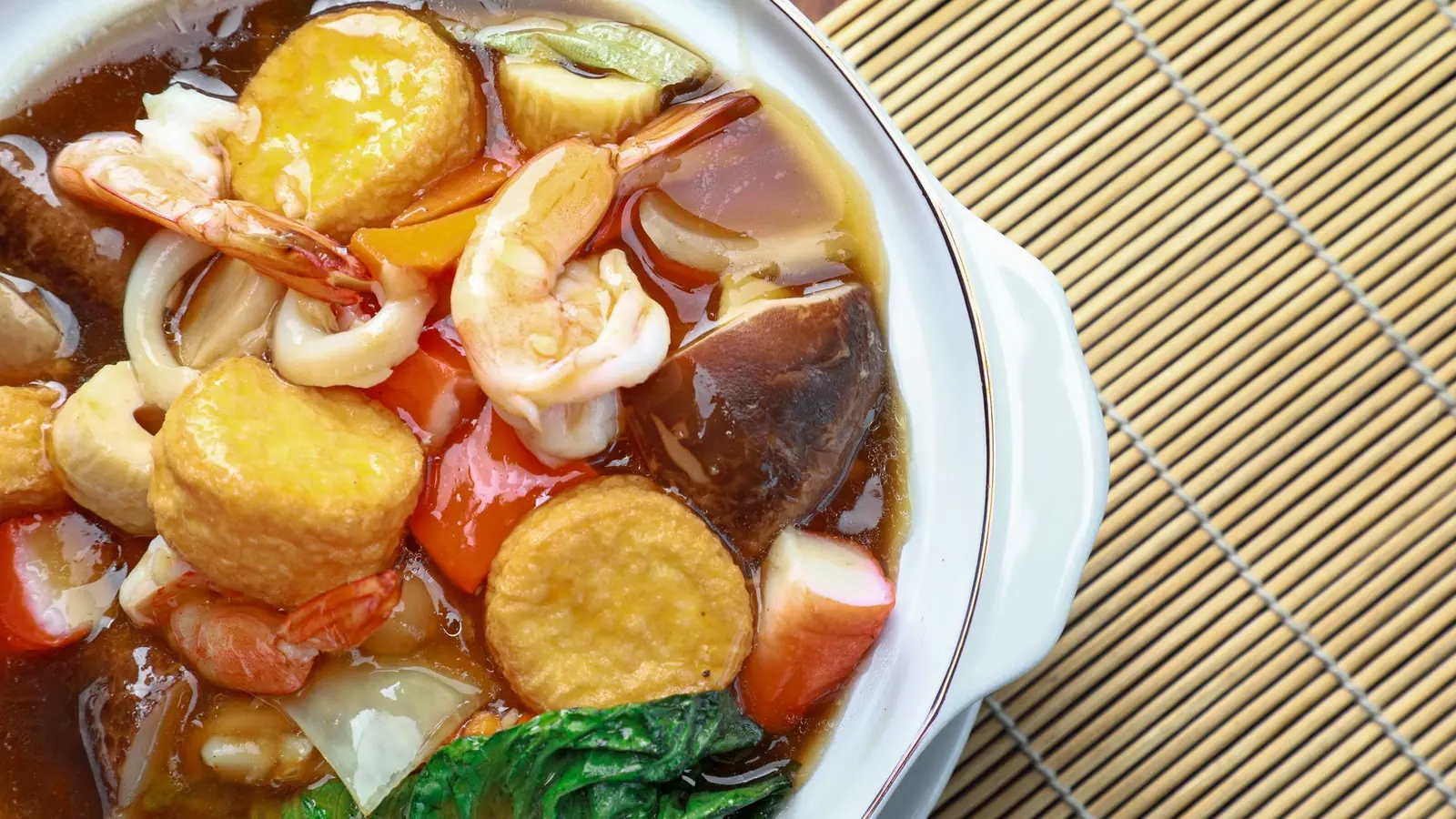
At a yong tau foo stall you pick your own pieces: tofu, bitter gourd, chilli, eggplant and fishballs, most of them stuffed with fish paste. The cook then serves them in a light, clear soup or dry with sweet sauce and chilli. You usually add noodles or rice. It's cheap, filling and lighter than a lot of hawker food, which is why office workers queue for it at lunch.
The dish started as a Hakka recipe of tofu stuffed with minced meat. In Singapore it became mostly fish paste, and the range of stuffed vegetables grew. This version uses fish paste bought ready-made from a wet market fishball stall or the chilled counter of most supermarkets, so you can skip the hardest part.
Ingredients
For the soup
- 2.5 litres water
- 40 g dried anchovies (ikan bilis), heads and dark gut removed, rinsed
- 50 g dried soybeans, rinsed (substitute: 2 more tablespoons ikan bilis, or leave them out)
- 3 cloves garlic, lightly smashed
- 1 teaspoon salt, plus more to taste
- 1 teaspoon sugar
- 1 tablespoon light soy sauce
For the filling
- 500 g raw fish paste, plain (sold by the fishball stall at wet markets, or chilled in tubs at FairPrice, Sheng Siong and Cold Storage)
- 100 g minced pork (optional; leave it out for an all-fish filling)
- 1 spring onion, very finely chopped
- 1/4 teaspoon white pepper
- 1 teaspoon sesame oil
- 1 teaspoon cornflour
For the pieces to stuff
- 2 blocks firm tofu (about 300 g each), each cut into 4 squares
- 6 tau pok (dried beancurd puffs)
- 1 small bitter gourd (about 300 g), cut into 2 cm rings, seeds and pith scooped out
- 4 large red chillies, slit lengthways, seeds removed
- 1 long Asian eggplant (brinjal), cut on the diagonal into 4 cm pieces, each slit open like a pocket without cutting through
- 6 lady's fingers (okra), slit lengthways along one side
To finish
- 12 fishballs
- 300 g leafy greens such as kang kong, chye sim or you mai cai, cut into 8 cm lengths
- 400 g fresh yellow noodles, thick bee hoon or kway teow (optional; or serve with rice)
- 2 spring onions, sliced
- 2 tablespoons fried shallots
For the dry version sauce
- 4 tablespoons sweet sauce (tim cheong) or hoisin sauce
- 1 tablespoon water
- 1 teaspoon toasted sesame seeds
- Bottled chilli sauce, to serve
Method
- Put the soybeans in a bowl of cold water and leave them to soak for 1 hour. You can skip this step, but the soup will be less sweet.
- In a large pot, toast the ikan bilis over medium heat for 2 to 3 minutes, stirring, until they smell nutty. Do not let them brown.
- Add the water, drained soybeans and garlic. Bring to a boil over high heat, then turn the heat down to low and simmer with the lid half on for 45 minutes.
- While the soup simmers, mix the fish paste, minced pork (if using), chopped spring onion, white pepper, sesame oil and cornflour in a bowl. Stir in one direction for 2 minutes until the mixture turns sticky and springy.
- Use a teaspoon to make a small pocket in the centre of each tofu square. Press in a heaped teaspoon of filling and smooth the top with a wet finger.
- Cut a slit in each tau pok and push in about 1 tablespoon of filling.
- Pack the hollow bitter gourd rings, the chillies, the eggplant pockets and the lady's fingers with filling. Wet your fingers first so the paste doesn't stick. Press the filling in firmly so it sits level with the vegetable.
- Roll any leftover paste into small balls and set them aside with the stuffed pieces.
- Strain the soup through a sieve into a clean pot and throw away the solids. Season with the salt, sugar and light soy sauce. Taste and adjust.
- Bring the soup back to a gentle simmer over medium-low heat. Add the stuffed bitter gourd and eggplant first and cook for 5 minutes.
- Add the stuffed tofu, tau pok, chillies, lady's fingers, fishballs and leftover paste balls. Simmer for 6 to 8 minutes, until the filling turns white all the way through and the fishballs float.
- Meanwhile, bring a second pot of water to the boil over high heat. Blanch the noodles for 30 to 60 seconds, then lift them into bowls. Blanch the greens for 1 minute in the same water.
- For the soup version, put the greens and the stuffed pieces on top of the noodles and ladle hot soup over them. Scatter over sliced spring onion and fried shallots.
- For the dry version, mix the sweet sauce with the water and toss it through the noodles. Pile the stuffed pieces on top, drizzle over a little more sauce and sprinkle with sesame seeds. Serve a small bowl of soup on the side.
- Serve with chilli sauce for dipping.
Tips
- Make ahead: you can stuff the pieces up to 1 day in advance. Keep them covered in the fridge and cook them straight from cold, adding 2 minutes.
- The soup keeps for 3 days in the fridge or 1 month in the freezer. Store cooked pieces and soup separately so the tofu doesn't go soggy.
- Don't boil hard once the stuffed pieces are in. A rolling boil pushes the filling out and clouds the soup.
- If the filling won't stick to the vegetables, dust the cut surfaces with a little cornflour before stuffing.
- For a pan-fried finish like some stalls do, fry the stuffed tofu filling-side down in 2 tablespoons oil over medium heat for 2 minutes before it goes into the soup.
- Bitter gourd turns less bitter if you blanch the rings for 1 minute and rinse them in cold water before stuffing.
Where to eat it in Singapore
- Xiu Ji Ikan Bilis Yong Tau Fu, Chinatown Complex Market & Food Centre, 335 Smith Street, #02-87/88. It was one of the 10 new names on the MICHELIN Guide Singapore Bib Gourmand list announced on 2026-07-28. The stall serves Hakka-style pieces in clear soup with crisp ikan bilis. The family's yong tau foo goes back to a roadside stall on Sago Lane in the 1960s. It's a morning and lunch stall that often sells out early, so go before noon.
- Heritage Yong Tau Foo, Chinatown Complex Food Centre, 335 Smith Street, #02-004. This stall makes Ipoh Hakka-style yong tau foo with handmade Spanish mackerel filling. A July 2026 review lists it as open 11am to 2pm, Wednesday to Sunday, and closed on Monday and Tuesday. Prices start from about SGD 4 for at least 3 pieces with noodles.
Hawker stall hours change often. Check before you make a special trip.
The story
According to an article in the National Library Board's BiblioAsia journal, "yong" means "stuffed" in the Hakka dialect. The name first meant just one thing, stuffed tofu. The Hakka moved south from northern China and could not find wheat flour for their festive dumplings, so they pushed ground meat into tofu instead. When Hakka migrants reached Southeast Asia in the 19th century, they started using fish paste and seafood because these were easy to get. Cantonese hawkers in Singapore later took up the dish and stuffed the filling into bitter gourd, chilli and eggplant. That is how yong tau foo became the name for a whole spread of stuffed, boiled pieces.
Last updated 24 Nov 2026 · Checked against official sources on 24 Nov 2026