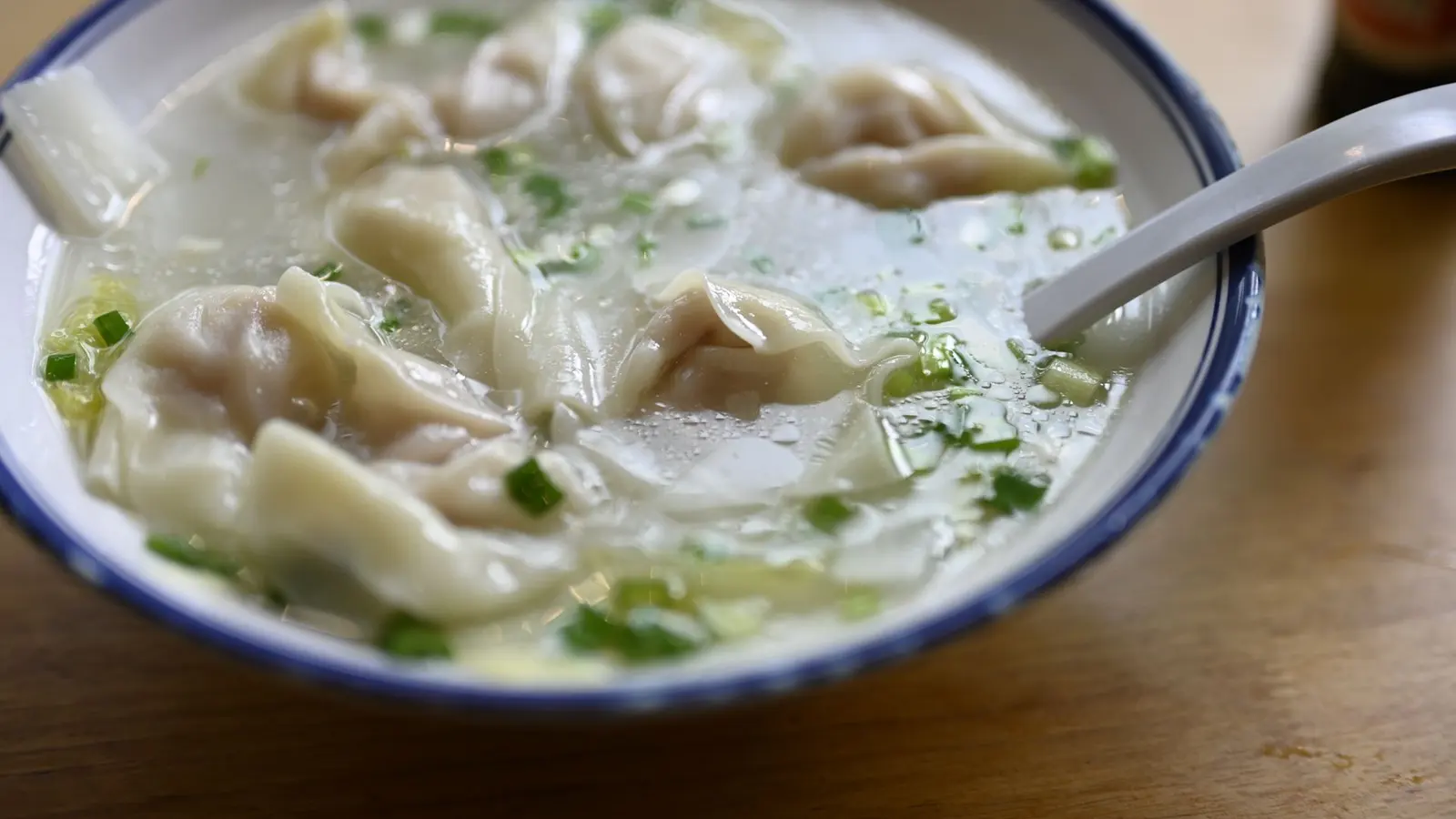
Wonton mee is thin egg noodles with barbecued pork (char siu), leafy greens and wontons. You can have it in soup, but in Singapore most people order it dry. The noodles are tossed in a dark, sweet and savoury sauce, and the wontons come on the side in a small bowl of soup. The name mixes two Chinese dialects. "Wanton" is the Cantonese word for dumpling and "mee" is the Hokkien word for noodle.
The dish came from Cantonese cooking, but the Singapore version has its own habits. Here the noodles are mixed with chilli sauce, and the plate comes with pickled green chillies on the side. This recipe gives you that hawker-style plate at home. The char siu is bought, the wontons are made from scratch, and the chilli sauce takes five minutes in a blender.
Ingredients
For the wontons
- 200 g minced pork, ideally with some fat
- 100 g raw prawns, peeled, deveined and finely chopped
- 1 spring onion, finely chopped
- 1 tbsp light soy sauce
- 1 tsp sesame oil
- 1/2 tsp sugar
- 1/4 tsp ground white pepper
- 1 tsp cornflour
- 1 tbsp cold water
- 24 thin square wonton wrappers (supermarket chiller or a wet market noodle stall)
For the noodles and toppings
- 4 bundles fresh thin egg noodles (mee kia), about 300 g. Sold at wet market noodle stalls and in supermarket chillers. Dried thin egg noodles work too; cook them as the packet says.
- 250 g char siu, bought from a roast meat stall or a supermarket deli, thinly sliced
- 200 g choy sum (cai xin), cut into 8 cm lengths. Kai lan or bok choy also work.
- Pickled green chillies, to serve. Sold in jars in most supermarkets.
For the shallot oil
- 100 ml vegetable oil
- 4 shallots, thinly sliced
- Shortcut: use 4 tbsp bottled shallot oil or lard instead
For the noodle sauce (enough for 4 plates)
- 4 tbsp oyster sauce
- 4 tsp light soy sauce
- 2 tsp dark soy sauce
- 4 tsp sesame oil
- 4 tbsp shallot oil (above)
- 1 tsp sugar
- 1/4 tsp ground white pepper
For the chilli sauce
- 8 fresh red chillies, roughly chopped (remove some seeds if you want it milder)
- 3 cloves garlic
- 3 tbsp white rice vinegar, or 2 tbsp calamansi or lime juice
- 1 tbsp sugar
- 1/2 tsp salt
- 2 tbsp water
For the wonton soup
- 1 litre chicken stock (homemade, carton or cube)
- 1/4 tsp ground white pepper
- 1 spring onion, chopped
- Salt, to taste
Method
- Make the chilli sauce. Blend the chillies, garlic, vinegar, sugar, salt and water until fairly smooth, about 1 minute. Taste, adjust the salt and sugar, and set it aside.
- Make the shallot oil. Put the oil and sliced shallots in a cold small pan. Heat on medium and fry, stirring often, for 6 to 8 minutes until the shallots are light golden. Strain at once and keep both the oil and the crispy shallots.
- Make the wonton filling. Mix the pork, prawns, spring onion, light soy sauce, sesame oil, sugar, pepper, cornflour and water. Stir hard in one direction for 2 minutes until it turns sticky.
- Fold the wontons. Put 1 heaped tsp of filling in the centre of a wrapper. Wet the edges with water, fold it into a triangle and press out the air. Bring the two side corners together and pinch to seal. Keep the finished wontons under a dry cloth.
- Mix the noodle sauce. Divide the oyster sauce, light and dark soy sauce, sesame oil, shallot oil, sugar and pepper between 4 serving plates. Add 1 to 2 tsp chilli sauce to each plate, to taste.
- Heat the soup. Bring the stock to a simmer on medium heat with the pepper. Season with salt and keep it hot on low heat.
- Bring a large pot of water to a rolling boil on high heat. Fill a big bowl with cold tap water and put it next to the stove.
- Blanch the greens. Boil the choy sum for 1 minute, lift it out and drain.
- Cook the wontons. Drop them into the same boiling water and cook for 3 to 4 minutes, until they float and the filling is firm. Move them to the hot stock.
- Cook the noodles one portion at a time. Loosen a bundle with your fingers and boil it for 30 to 45 seconds, stirring with chopsticks.
- Lift the noodles into the cold water and swish for 5 seconds. This stops the cooking and keeps them springy.
- Dip the noodles back into the boiling water for 5 seconds to reheat them, then shake off as much water as you can.
- Toss the hot noodles straight away in the sauce on a plate, until every strand is coated. Add 1 tbsp of the cooking water if the sauce is too thick.
- Top each plate with sliced char siu, choy sum and some crispy shallots. Serve with a bowl of wontons in soup, pickled green chillies and extra chilli sauce.
Tips
- Fresh mee kia cooks in under a minute, so get everything else ready before the noodles go in.
- Do not skip the cold rinse. It is what gives the noodles their bite.
- Shake the noodles well after the last dip. Leftover water thins the sauce and makes it bland.
- Make ahead: uncooked wontons freeze well for up to 1 month. Freeze them on a tray, then bag them. Cook them from frozen and add 1 to 2 minutes.
- The chilli sauce keeps in a clean jar in the fridge for about 1 week, and the shallot oil for about 2 weeks.
- Leftover cooked noodles go soft. Cook only what you will eat.
Where to eat it in Singapore
These addresses and hours come from Eatbook's wonton mee guide (published 2025-06-05). Hawker hours change often, so check before you go.
- Hua Kee Hougang Famous Wan Ton Mee: 51 Old Airport Road, #01-35, Old Airport Road Food Centre, Singapore 390051. Listed as open Wednesday to Monday, 10am to 8pm. It has a Michelin Plate, and the guide says its history goes back to the 1930s.
- Eng's Char Siew Wantan Mee: 360 Joo Chiat Road, Singapore 427605. Listed as open Tuesday to Sunday, 10.30am to 8.30pm.
- Fei Fei Roasted Noodle: 254 Jurong East Street 24, #01-28, Yuhua Village Market and Food Centre, Singapore 600254. Listed as open Monday to Saturday.
The story
According to SG101, wanton mee in Singapore uses thin egg noodles. They are cooked until just firm, then rinsed in cold water so they stay springy. The dish is served either dry, in a sauce of soy sauce, oyster sauce and chilli, or in a pork and chicken broth. Singapore stalls usually add chilli sauce and pickled green chillies for local tastes. Some stalls have been around for generations. The National Heritage Board's Roots site describes a stall on the Geylang Serai food trail, now at Haig Road Cooked Food Centre, that started at the Hollywood Cinema Food Centre in the 1960s. A husband-and-wife team runs it and still serves dry noodles with handmade char siu.