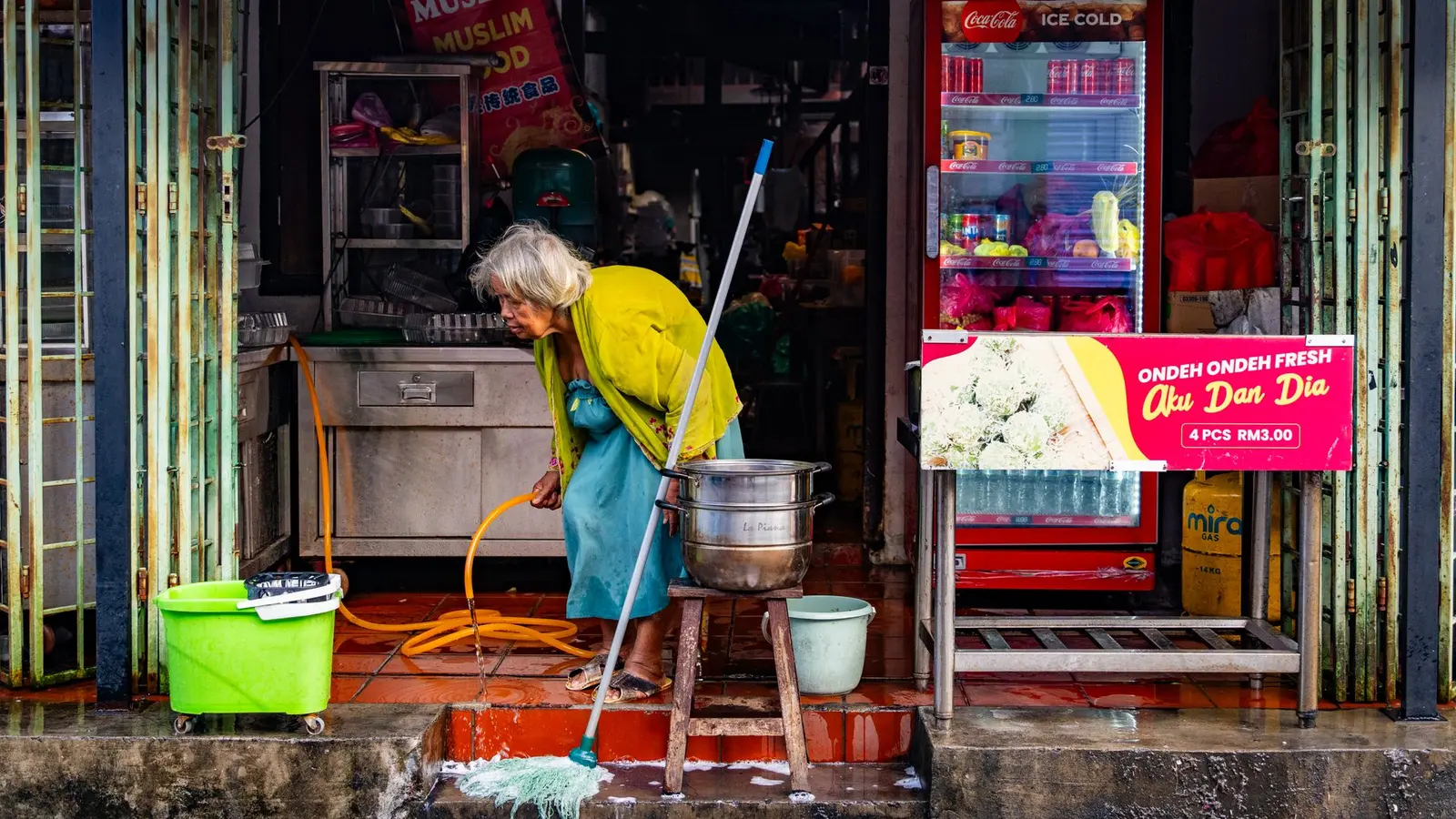
Ondeh-ondeh are small green balls of glutinous rice dough. Each one holds a piece of gula melaka (palm sugar), and the balls are rolled in grated coconut. The dough is coloured and scented with pandan juice. The sugar melts while the balls cook, so the centre bursts into a warm syrup when you bite in.
In Singapore, ondeh-ondeh is one of the best-known Nonya kueh. You will find it at kueh shops, hawker stalls and bakery chains across the island. Everything in it is easy to find here: pandan grows in many gardens and is sold at every wet market, gula melaka comes in cylinders or blocks, and coconut stalls will grate fresh coconut for you on the spot.
Ingredients
Makes about 25 balls.
For the pandan juice
- 10 pandan leaves (about 40 g), washed
- 180 ml water
For the dough
- 200 g glutinous rice flour
- 150 to 170 ml pandan juice (from above)
- 1 pinch salt
For the filling
- 100 g gula melaka, finely chopped or shaved
For the coating
- 150 g fresh grated white coconut (ask for the skinned, white kind at a wet market coconut stall)
- 1/4 tsp salt
- 1 pandan leaf, knotted
Substitutes
- No pandan leaves: mix 1/2 tsp pandan paste into 160 ml water. The colour will be brighter and the flavour less fresh.
- No gula melaka: use dark muscovado or coconut sugar. The taste will be less smoky.
- No fresh coconut: soak 100 g desiccated coconut in 60 ml warm water or coconut milk for 10 minutes before steaming.
Method
- Cut the pandan leaves into 2 cm pieces. Blend them with the 180 ml water on high for 1 minute.
- Strain through a fine sieve or muslin cloth, pressing hard on the pulp. You should get about 170 ml of green juice.
- Mix the grated coconut with the 1/4 tsp salt. Put it in a heatproof dish with the knotted pandan leaf on top.
- Steam the coconut over high heat for 5 minutes. Spread it on a large plate to cool and discard the leaf.
- Put the glutinous rice flour and pinch of salt in a bowl. Pour in 150 ml of the pandan juice.
- Knead for 3 to 4 minutes until the dough is smooth and soft, like play dough. Add the remaining juice a teaspoon at a time only if it cracks.
- Cover the bowl with a damp cloth so the dough does not dry out.
- Bring a large pot of water to a rolling boil over high heat.
- Pinch off a piece of dough about 15 g (the size of a large marble). Roll it into a ball, then press a deep well in the middle with your thumb.
- Put about 1/2 tsp gula melaka in the well. Pinch the dough closed over it and roll gently between your palms until smooth with no gaps.
- Repeat with the rest of the dough. Keep the shaped balls on a tray under the damp cloth.
- Lower 8 to 10 balls into the boiling water. Keep the heat on medium-high.
- When the balls float to the top (about 2 to 3 minutes), let them cook 1 more minute so the sugar fully melts.
- Lift them out with a slotted spoon, let excess water drip off for a few seconds, and roll straight into the coconut.
- Repeat with the remaining batches. Serve warm or at room temperature.
Tips
- Seal each ball well. Any small gap lets the syrup leak into the water and leaves the centre hollow.
- Chop the gula melaka fine. Big chunks may not melt in the short cooking time.
- If the dough is too dry, it cracks when you fill it. If it is too wet, the balls flatten. Adjust with juice or flour a little at a time.
- Ondeh-ondeh is best eaten the same day. Fresh coconut spoils quickly in Singapore's heat, so keep leftovers covered in the fridge and eat within 1 day. The dough firms up when cold; let it sit at room temperature for 20 minutes before eating.
- To get ahead, shape the filled balls up to 2 hours before cooking and keep them covered. Steam the coconut close to serving time.
- Bite carefully when they are fresh from the pot: the syrup is very hot.
Where to eat it in Singapore
- Bengawan Solo: the kueh and cake chain sells ondeh-ondeh in boxes. Outlets include ION Orchard (2 Orchard Turn, #B4-38), Raffles City (252 North Bridge Road, #B1-02A) and Changi Airport Terminal 1, handy for a last box before a flight. Check its store list for hours.
- HarriAnns Nonya Table: a Nonya kueh specialist with outlets at Tiong Bahru Food Centre (30 Seng Poh Road, #02-25, closed Mondays except public holidays), Suntec City West Wing and Bugis Junction Towers.
- Kim Choo Kueh Chang: the Peranakan shop at 60 Joo Chiat Place, best known for its rice dumplings, also sells ondeh-ondeh. Pair a visit with a walk around Joo Chiat and Katong.
The story
Ondeh-ondeh belongs to the family of Nonya kueh, the bite-sized sweets that Singapore's government heritage resource SG101 describes as showing the mix of influences found across the region, built on local ingredients such as rice, coconut and gula melaka. According to SG101, the name comes from "onde", the Indonesian word for a sphere. Its description matches the recipe still made today: pandan-flavoured balls of glutinous rice or sweet potato dough, filled with palm sugar and coated in freshly grated coconut.