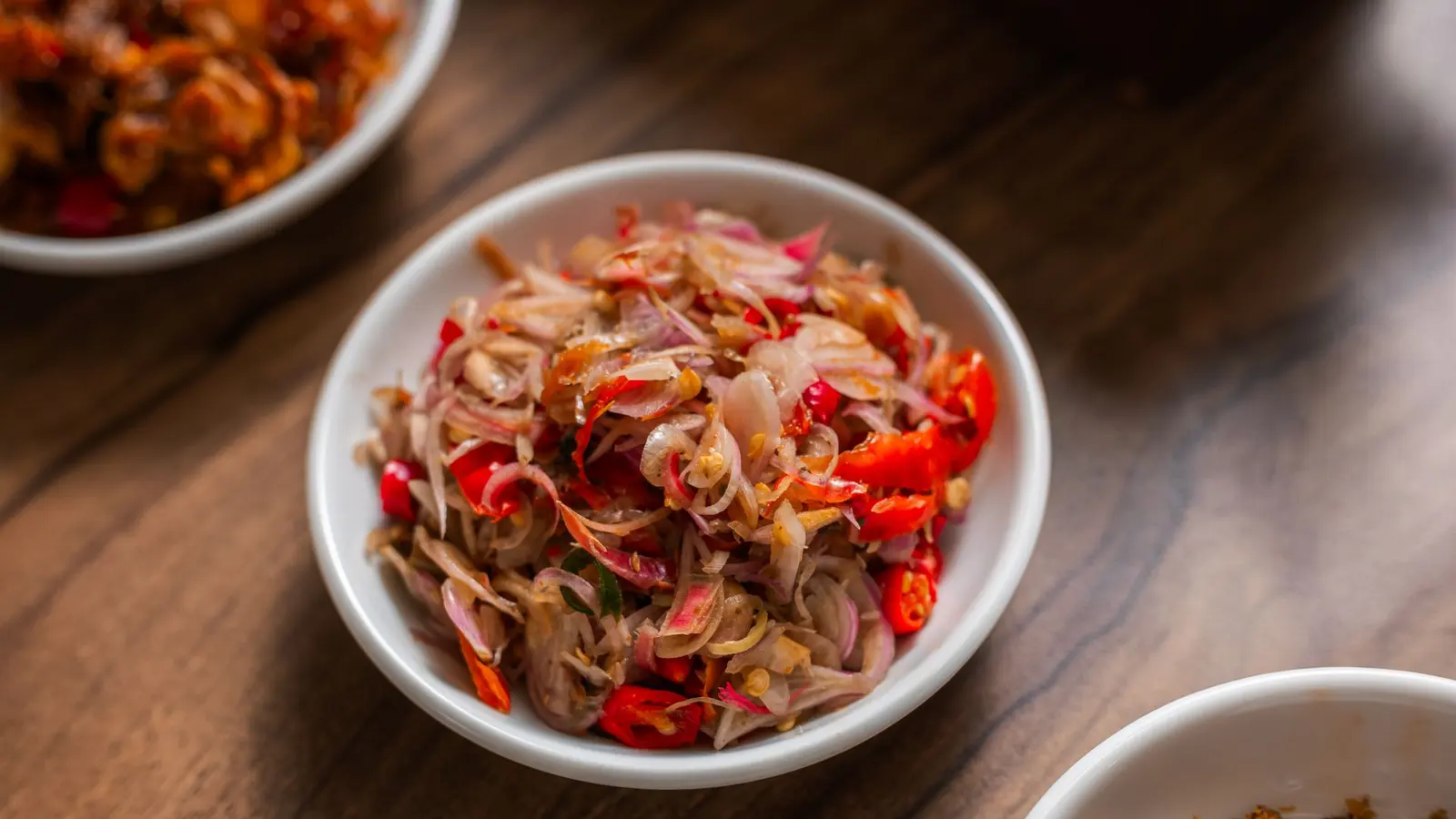
Sambal belacan is a fiery paste of fresh red chillies pounded with toasted shrimp paste (belacan) and sharpened with lime. In Singapore it sits on the side of the plate at Malay, Peranakan and Chinese meals. People eat it with rice, fried fish, omelettes and raw vegetables, and cooks also use it as the base for stir-fries such as sambal kangkong.
What makes it Singaporean is the belacan, a dark, pungent block of fermented tiny shrimp, plus calamansi (limau kasturi), the small, fragrant local lime. You can buy both at any wet market and at most supermarkets, so a good sambal belacan is one of the easiest local dishes to make at home.
Ingredients
For the sambal
- 100 g fresh red chillies (about 8 to 10 large ones)
- 3 to 5 chilli padi (bird's eye chillies), optional, for extra heat
- 20 g belacan (shrimp paste), about a slice 1 cm thick cut from a block
- 4 to 6 calamansi limes, or 1 regular lime
- 1 tsp sugar
- 1/4 tsp salt
Substitutes
- Calamansi: a regular green lime works. Use a little less, because it is sharper.
- Chilli padi: any small Thai bird's eye chilli, or leave them out for a milder paste.
- Belacan: Thai shrimp paste (kapi) is softer and a little saltier. It works, but taste before you add the salt.
Method
- Cut the stems off the red chillies. For a milder sambal, slit them open and scrape out some of the seeds. Roughly chop the chillies and chilli padi.
- Break the belacan into thin flakes or flatten it into a thin disc so it toasts evenly.
- Heat a dry frying pan over low to medium heat. Add the belacan with no oil.
- Toast for 4 to 5 minutes, pressing and turning it with a spatula, until it is dry, crumbly, a shade darker and very fragrant. Do not let it blacken.
- Tip the toasted belacan into a mortar (batu lesung) or a small blender and let it cool for 1 minute.
- Add the chopped chillies, sugar and salt.
- Pound for 5 to 8 minutes, or pulse in the blender, until you have a rough paste with small flecks of chilli. If the blender struggles, add 1 to 2 tsp of water.
- Halve the calamansi and squeeze the juice over the paste just before serving. Stir and taste, then add more salt, sugar or lime as you like.
Tips
- Open the windows. Toasting belacan smells strong and the smell lingers. Turn on the hood, or wrap the belacan in a foil parcel and toast it in the pan or oven to keep the smell down.
- Add lime at the end. Store the paste without lime and squeeze fresh calamansi over each portion when you serve it. The flavour stays brighter that way.
- Fridge storage: keep the paste in a clean, dry glass jar with a tight lid. Always use a clean, dry spoon, and eat it within about a week.
- Freezer storage: freeze small portions in an ice cube tray, then move the cubes to a sealed bag. Thaw one cube in the fridge when you need it.
- Toast extra belacan. Toast a larger batch, let it cool, and keep it in an airtight jar in the fridge. You can then make fresh sambal in a few minutes.
- Common mistake: burnt belacan tastes bitter and spoils the whole batch. Keep the heat low and take it off the moment it smells toasty.
- Where to shop: blocks of belacan are sold at wet markets and supermarkets. Calamansi and chilli padi are easy to find at wet market vegetable stalls.
Where to eat it in Singapore
- Chilli Padi Nonya Restaurant, 11 Joo Chiat Place #01-03. This Peranakan restaurant in Joo Chiat describes its sambal belacan as its house speciality.
- True Blue Cuisine, 47/49 Armenian Street. A Peranakan restaurant next to the Peranakan Museum, listed in the Michelin Bib Gourmand since 2016. Check the menu for dishes made with sambal belacan.
- Violet Oon Singapore at Dempsey Hill, 7 Dempsey Road #01-05. A well-known Peranakan and local restaurant, open daily for lunch and dinner. Check the menu for dishes made with sambal belacan.
The story
The National Heritage Board's Roots lists the making and use of sambal as part of Singapore's intangible cultural heritage. It describes sambal belacan as the version with a pungent finish that comes from fermented shrimp, and notes that sambal was traditionally ground in a batu lesung. Roots also points to an 1879 book by J. D. Vaughan that already mentions sambal being made in Singapore. Belacan was once made here as well. A National Library BiblioAsia article records 36 registered belacan factories in Singapore's municipal area in 1900, with only three left by 1939. It also notes that the belacan sold here today is usually made from udang geragau, a tiny krill-like shrimp.