
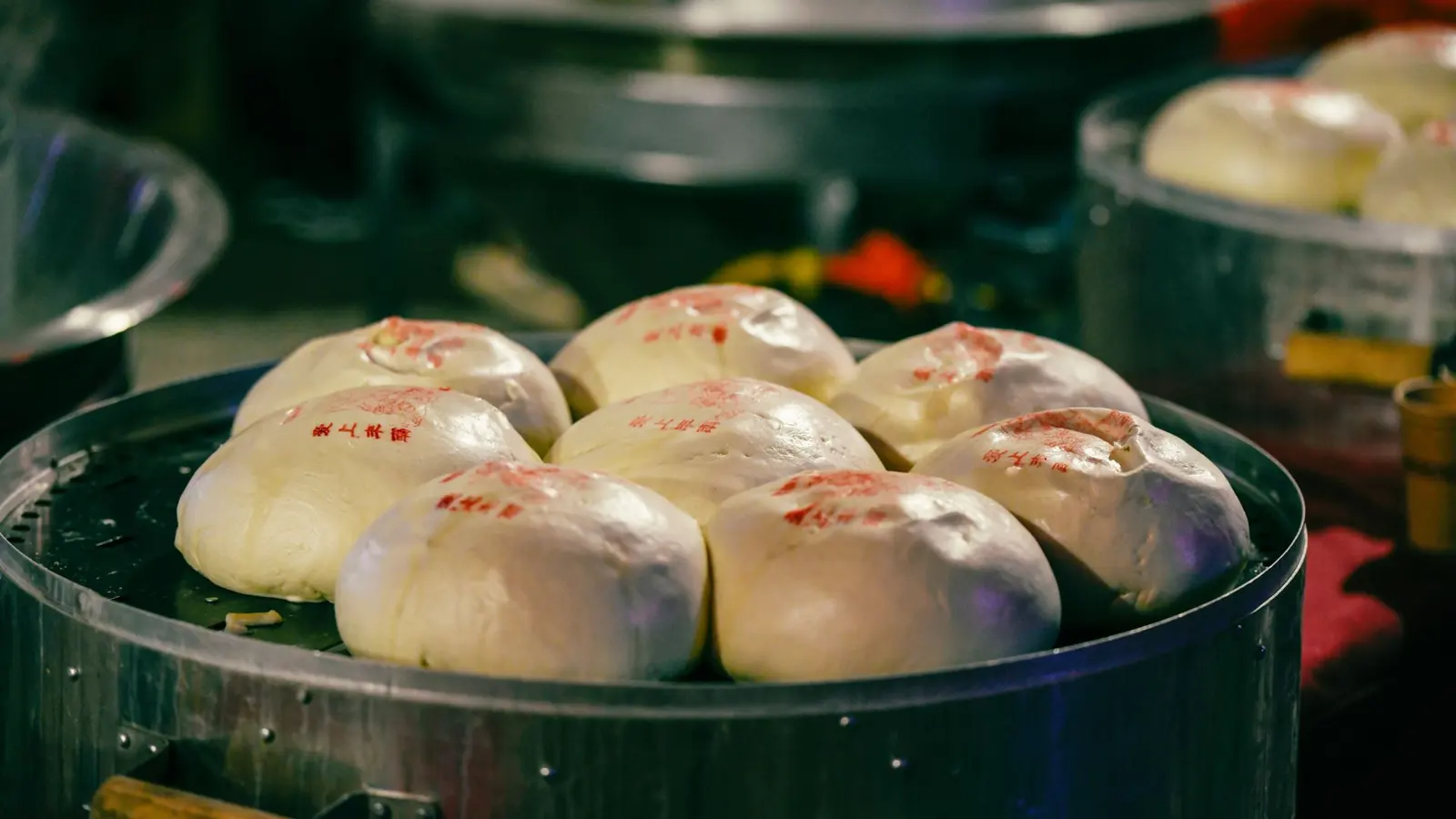
Kong bak pau is a thick slice of pork belly braised slowly in dark soy, rock sugar and warm spices, then tucked into a soft, folded white bun with a leaf of lettuce to cut the richness. It is sticky, savoury and slightly sweet, and you eat it with your hands.
In Singapore it is known as a Hokkien dish. The Hokkiens are the country's largest Chinese dialect group, and this bun is one of the dishes most closely tied to them. You will still find it at old-school Chinese restaurants here, usually served as a platter of buns with the pork and sauce on the side so everyone can build their own.
Ingredients
For the braised pork
- 800 g pork belly in one piece, skin on (ask the butcher at a wet market or supermarket meat counter for an even, layered slab)
- 1 tbsp cooking oil
- 6 cloves garlic, lightly smashed, skins left on
- 4 thin slices ginger
- 30 g rock sugar (or 25 g brown sugar)
- 3 tbsp dark soy sauce
- 3 tbsp light soy sauce
- 2 tbsp Shaoxing wine (or dry sherry, or leave it out)
- 2 star anise
- 1 cinnamon stick, about 5 cm
- 2 cloves
- 1/4 tsp five-spice powder
- 600 ml water
For the buns (makes 12)
- 300 g pau flour, also sold as Hong Kong flour (plain flour works, the buns will be a little less white)
- 30 g sugar
- 1 tsp instant yeast
- 1 tsp baking powder
- 160 ml lukewarm water
- 1 tbsp cooking oil, plus a little extra for brushing
Short on time? Use ready-made frozen folded buns (sometimes labelled lotus leaf buns) and steam them following the packet.
To serve
- 1 small head butterhead or green coral lettuce, leaves separated, washed and dried
- A few sprigs of coriander (optional)
- Sliced red chilli or chilli sauce (optional)
Method
- Bring a pot of water to the boil. Add the whole pork belly and boil for 5 minutes. Drain and rinse off any scum under the tap. Pat dry.
- Heat the oil in a heavy pot over medium-high heat. Sear the pork skin-side down for 3 to 4 minutes until golden, then brown the other sides for 1 minute each. Stand back, it will spit.
- Take the pork out and cut it into slices about 1 cm thick and 8 cm long, so they will fit a bun.
- In the same pot over medium heat, fry the garlic and ginger for 1 minute until fragrant.
- Add the rock sugar and stir for about 2 minutes until it melts and turns amber.
- Return the pork to the pot. Add the dark soy, light soy, Shaoxing wine, star anise, cinnamon, cloves, five-spice and water. Bring to the boil.
- Turn the heat to low, cover and simmer gently for 1 hour 30 minutes, turning the slices once halfway. The liquid should only bubble lazily.
- While the pork cooks, make the dough. Mix the flour, sugar, yeast and baking powder in a bowl. Add the water and oil and mix into a shaggy dough.
- Knead for about 10 minutes until smooth and springy. Cover and leave in a warm spot for about 1 hour, until doubled.
- Punch the dough down and divide into 12 pieces of about 40 g each. Roll each into an oval about 10 cm by 7 cm.
- Brush one half of each oval lightly with oil, fold it over a chopstick, then pull the chopstick out. Set each bun on a small square of baking paper.
- Cover the buns and leave to rise for 20 to 30 minutes, until puffy.
- Steam the buns over boiling water on high heat for 10 to 12 minutes. Turn off the heat and wait 3 minutes before lifting the lid.
- Uncover the pork, raise the heat to medium and reduce the sauce for 10 to 15 minutes, until it is glossy and coats the back of a spoon. Skim off excess fat and remove the whole spices.
- To serve, open a warm bun, add a lettuce leaf and a slice of pork, and spoon over a little sauce. Add coriander and chilli if you like.
Tips
- Make the pork a day ahead. Chill it overnight, lift off the set fat, then reheat gently. The flavour is better the next day.
- Cooked pork keeps for 3 days in a covered container in the fridge.
- Steamed buns freeze well. Re-steam from frozen for about 8 minutes.
- Keep the braise at a gentle simmer. A hard boil makes the meat tough and stringy instead of soft.
- Do not skip the blanching step. It keeps the sauce clean and less greasy.
- Wrap the steamer lid in a tea towel so water does not drip onto the buns and leave marks.
- For a pork-free version, use 800 g boneless chicken thighs and cut the simmering time to about 40 minutes.
Where to eat it in Singapore
- Westlake Restaurant, Block 4 Queen's Road, #02-139, Singapore 260004, near Farrer Road MRT (Exit B). The restaurant says it was set up in 1974 and calls its braised pork with pau a signature dish. Its website lists daily lunch from 11am to 2pm and dinner from 5pm to 9pm. Phone 6474 7283.
- Bao Bao, ION Orchard, 2 Orchard Turn, #B4-34, Singapore 238801. This is a kiosk selling handmade buns, including a braised pork belly bao (SGD 2.90 in a November 2025 listing). It is a closed round bun, not the folded style, but the filling is in the same family. Listed as open daily from 10am to 10pm.
Opening hours and prices change, so check before you go.
The story
The Singapore Chinese Cultural Centre counts kong bak pau among the signature dishes of the Hokkien community, alongside popiah and ngo hiang. Most Hokkien migrants came from Fujian province in the late 19th and early 20th centuries, escaping poverty and unrest, and many settled around the Singapore River and Telok Ayer. Pork was a common livestock meat back in Fujian, which explains its strong place in Hokkien cooking here, from kong bak pau to bak kwa and bak kut teh. The Cultural Centre also notes that only a handful of traditional Hokkien restaurants are left in Singapore, so cooking this at home is one way to keep it going.
Last updated 24 Nov 2026 · Checked against official sources on 24 Nov 2026