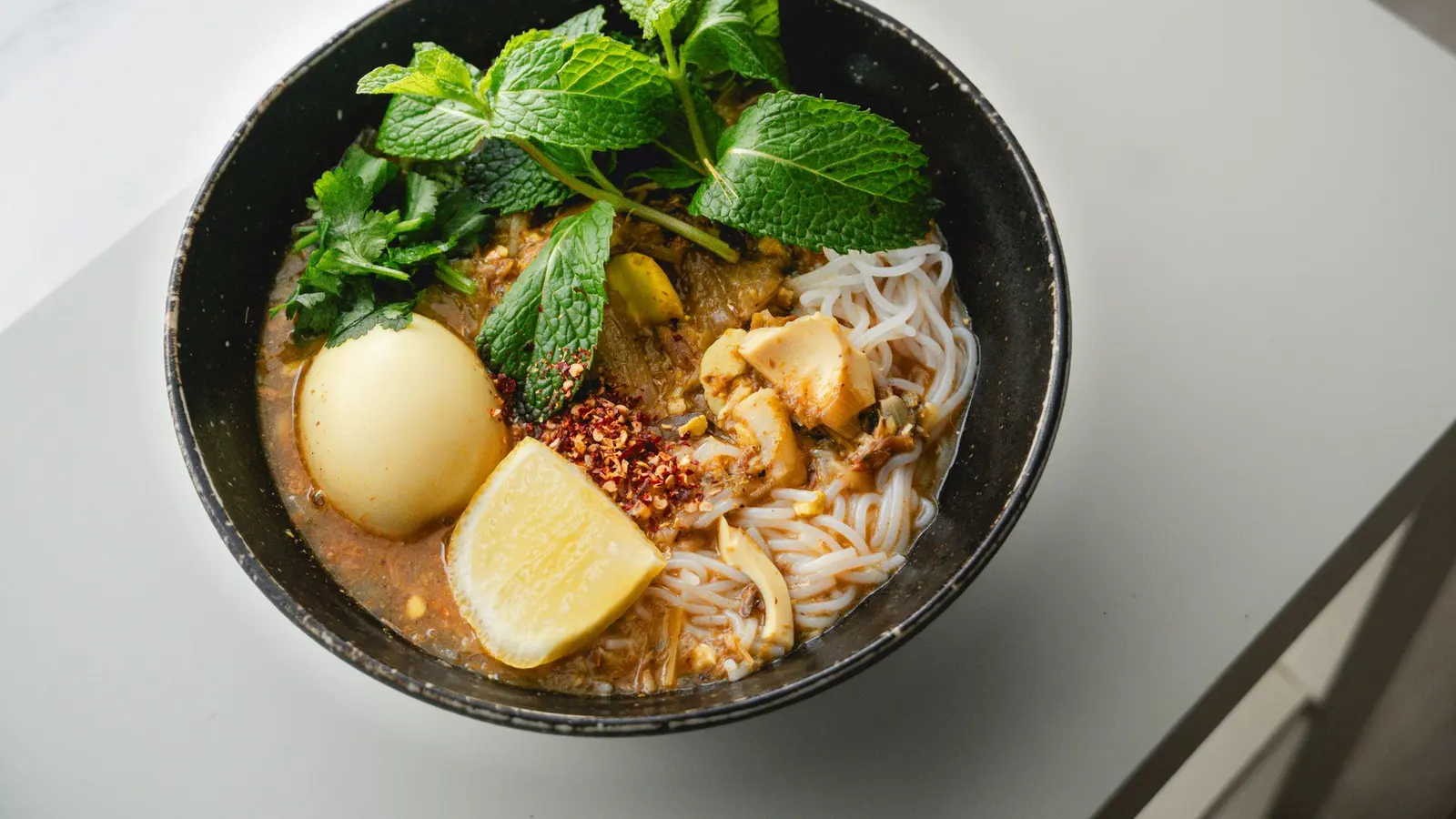
Mee siam is thin rice vermicelli (bee hoon) cooked with a red chilli paste, then served in a thin, tangy gravy made with tamarind, fermented soya beans and dried shrimp. On top go hard-boiled egg, fried beancurd puffs (tau pok), bean sprouts and Chinese chives. A spoon of sambal and a squeeze of calamansi lime finish each plate. You can find it at hawker centres across the island for breakfast or an early lunch.
The dish is Singaporean because so many communities here have made it their own. Malay, Chinese, Indian and Peranakan cooks each have their own version, and that mix is part of its appeal. This recipe makes a Malay-Peranakan style plate with a clear, sweet-sour gravy and no coconut.
Ingredients
For the spice paste (rempah)
- 25 g dried red chillies, snipped into pieces, seeds shaken out (or 4 tbsp ready-made chilli boh from a jar)
- 10 shallots (about 150 g), peeled
- 4 cloves garlic, peeled
- 40 g dried shrimp (hae bee)
- 10 g belacan (shrimp paste)
- 120 ml cooking oil
For the gravy
- 60 g tamarind pulp (asam), sold in blocks
- 1.5 litres water, plus 250 ml for the tamarind
- 2 tbsp taucheo (salted fermented soya beans), lightly mashed (or 1 tbsp white miso)
- 3 tbsp sugar, or 40 g gula melaka
- 1 tsp salt, plus more to taste
For the noodles
- 400 g dried thin rice vermicelli (bee hoon)
- 300 g bean sprouts (tau geh), tails picked if you have time
- 2 tbsp light soy sauce
For the toppings
- 4 eggs
- 4 tau pok (fried beancurd puffs), about 80 g (or 150 g firm tofu, cubed and pan-fried)
- 50 g Chinese chives (ku chye), cut into 3 cm lengths (or spring onions)
- 8 calamansi limes, halved (or 2 regular limes, cut into wedges)
- 200 g medium prawns, peeled (optional)
Method
- Soak the dried chillies in hot water for 20 minutes. In a separate bowl, soak the dried shrimp in warm water for 15 minutes, then drain.
- Put the tamarind pulp in a bowl with 250 ml warm water. Squeeze it with your fingers for 2 minutes, then strain through a sieve, pressing on the pulp. Keep the liquid and throw away the seeds and fibre.
- Soak the bee hoon in a large bowl of room-temperature water for 15 minutes until soft and bendy, then drain well in a colander.
- Wrap the belacan in foil and toast it in a dry pan over medium heat for 2 minutes per side, until it smells strongly.
- Drain the chillies. Blend them with the shallots, garlic, half the dried shrimp, the toasted belacan and 3 tbsp oil into a smooth paste.
- Heat the remaining oil in a wok over medium-low heat. Add the paste and fry for 15 to 20 minutes, stirring often, until it turns dark red and the oil separates from it.
- Take out one third of the fried paste and set it aside for the noodles. Take out 4 more tbsp and set aside in a small bowl as your sambal.
- Boil the eggs for 10 minutes, cool them in cold water, peel and halve them.
- Slice each tau pok into thin strips. If you are using prawns, poach them in simmering water for 2 minutes and drain.
- For the gravy, put the rest of the paste in a pot with 1.5 litres water, the tamarind liquid, mashed taucheo, sugar and salt. Bring to a boil over high heat.
- Lower the heat and simmer for 15 minutes. Taste it. It should be sour first, then sweet, with gentle heat. Add sugar or salt a little at a time to balance it.
- Add the tau pok strips to the gravy for the last 5 minutes so they soak it up.
- For the noodles, heat the reserved third of the paste in a wok over medium-high heat for 1 minute. Add the remaining dried shrimp and fry for 1 minute.
- Add the drained bee hoon and soy sauce. Toss with tongs or chopsticks for 3 to 4 minutes until every strand is coated and red.
- Add the bean sprouts and half the chives. Toss for 1 minute more, then turn off the heat.
- Divide the noodles between 4 deep plates. Ladle hot gravy and tau pok over each one.
- Top each plate with egg halves, prawns if using, the rest of the chives, a spoon of sambal and calamansi on the side. Squeeze the lime over just before eating.
Tips
- Tamarind blocks, taucheo, belacan, dried shrimp and bee hoon are sold at NTUC FairPrice, Sheng Siong and most wet markets. Tau pok is in the chilled tofu section.
- Fry the paste slowly. If it is undercooked the gravy tastes raw and sharp. If it is on high heat it burns and turns bitter.
- Do not boil the bee hoon. Soaking is enough, and boiled vermicelli breaks up in the wok.
- Make ahead: the fried paste keeps for 1 week in a sealed jar in the fridge, or 3 months in the freezer. The gravy keeps for 3 days in the fridge.
- Store the noodles, gravy and toppings separately. Mixed leftovers turn soggy.
- For less salt, cut back on the taucheo and add extra lime at the table instead.
Where to eat it in Singapore
Hours below are from a food guide updated on 2026-06-18. Stalls run by one or two people can close at short notice, and many sell out before noon, so go early.
- Aziz Jaffar Muslim Food, Chinatown Complex Food Centre, 335 Smith Street, #02-70. This long-running Malay stall serves a slightly sweet mee siam with tofu, egg and sambal. Open Tuesday to Friday 7am to 2pm, Saturday and Sunday 7am to 12pm. Closed Monday.
- Shi Xian, Ang Mo Kio Market and Food Centre, 409 Ang Mo Kio Avenue 10, #01-24. Known for mee siam and mee rebus, with crispy dried shrimp and a peanut sambal. Open Wednesday to Sunday 7am to 12.30pm. Closed Monday and Tuesday.
- Hup Hup Mee Siam Laksa Lor Mee, Circuit Road Market and Food Centre, 80 Circuit Road, #02-14. A Chinese-style version with ground peanuts in the gravy. Open Wednesday to Sunday 6am to 2.30pm. Closed Monday and Tuesday.
- Grandma Mee Siam, Tekka Centre, 665 Buffalo Road, #01-311. A light, sourish gravy from a family recipe going back to 1963. Open Wednesday to Saturday 8am to 3pm. Closed Sunday to Tuesday.
The story
In Malay, mee siam means "Thai noodles", and Siam is the old name for Thailand. The National Library Board's Singapore Infopedia says the earliest mention in local newspapers comes from 1950, when hawkers at the Esplanade sold it to people out for an evening walk. Nobody agrees on where it started. Some writers trace it to Thailand. Others call it a Malay dish, a Straits Chinese (Peranakan) creation, or a Penang dish with Thai influences. One theory says the name comes from vermicelli imported from Siam in the early 20th century. Sociologist Chua Beng Huat described it as a hybrid of Chinese, Malay, Peranakan and Thai flavours. Today Singapore has Malay, Chinese, Indian and Peranakan versions. The National Heritage Board counts mee siam among the noodle dishes that became mainstays of Malay cooking here.