
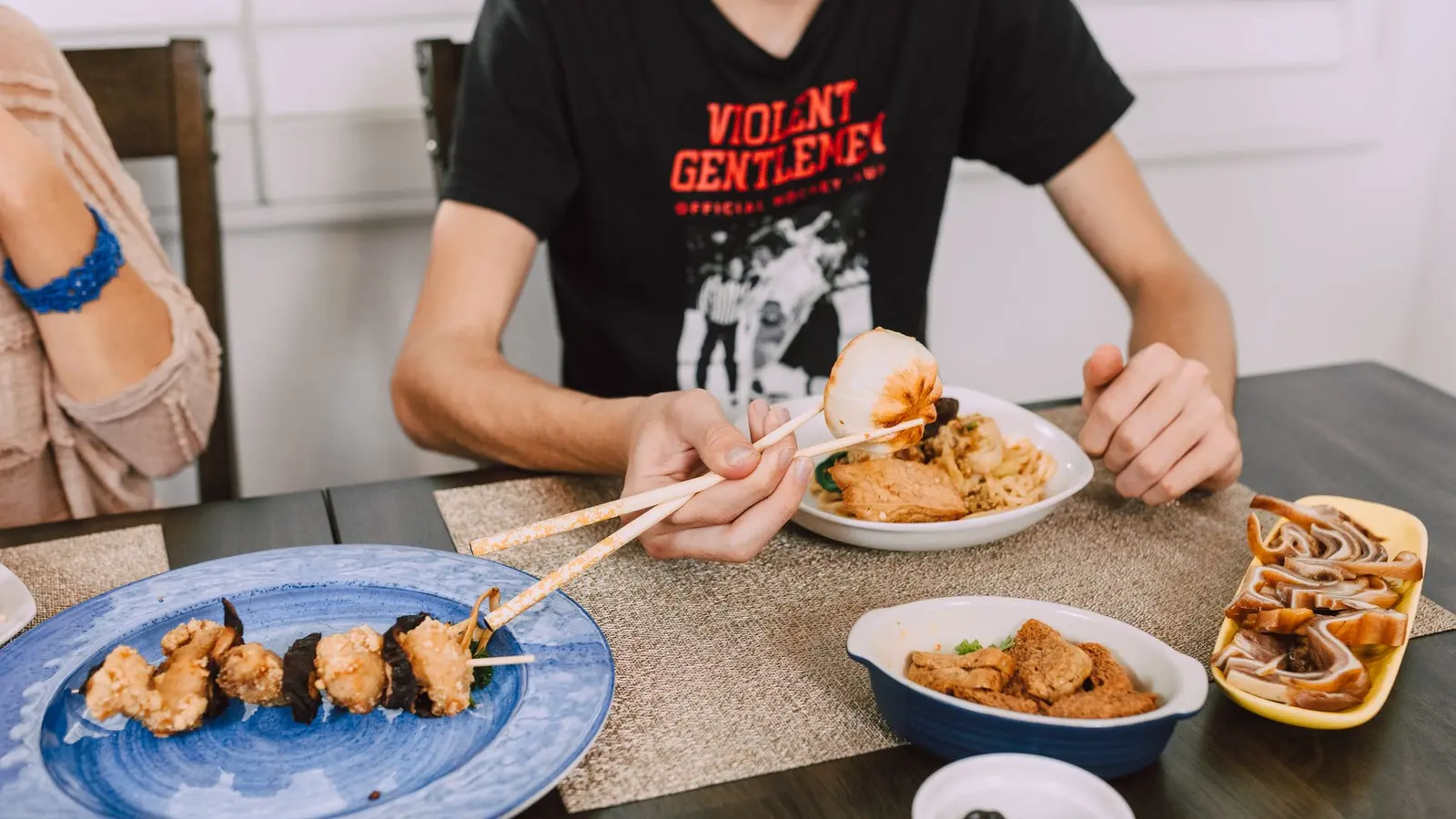
Mala xiang guo is a dry spicy stir-fry. Each person picks their own mix of meat, seafood, tofu, mushrooms and vegetables, and everything is tossed in a wok with a numbing, fiery sauce. The name sums up the flavour: ma is the tingle from Sichuan peppercorns, la is the heat from dried chillies, and xiang guo means a fragrant pot.
In Singapore it is a food court and hawker centre favourite. You fill a basket, the stall weighs it, and you choose how spicy you want it. Local stalls usually cook it with less oil and salt than you might expect, and they offer a mild level for people who are new to the numbing heat. This recipe gives you that same pick-your-own meal at home. Swap the add-ins for whatever you like.
Ingredients
For the mala sauce
- 3 tbsp neutral oil (canola or peanut)
- 1 tbsp Sichuan peppercorns (hua jiao)
- 10 to 15 dried red chillies, snipped into 2 cm pieces, seeds shaken out for less heat
- 6 cloves garlic, sliced
- 20 g ginger, sliced into thin coins
- 2 stalks spring onion, white parts cut into 3 cm lengths (keep the greens for garnish)
- 80 g store-bought mala hotpot soup base (the solid block or paste kind), roughly chopped
- 1 tbsp doubanjiang (Sichuan chilli bean paste)
- 1 tbsp light soy sauce
- 1 tsp sugar
- 1 tbsp Shaoxing wine (optional)
For the pot
- 300 g pork belly or chicken thigh, thinly sliced
- 200 g prawns, peeled with tails left on
- 200 g luncheon meat, cut into thick strips
- 150 g fish balls or fish tofu
- 1 block (about 300 g) firm tofu, cut into cubes, or 100 g fried tofu puffs
- 150 g lotus root, peeled and sliced 5 mm thick
- 150 g potato, peeled and sliced 5 mm thick
- 200 g mixed mushrooms (enoki, shiitake, king oyster, black fungus)
- 200 g leafy greens (Chinese cabbage, xiao bai cai or kang kong)
- 100 g bean sprouts
- 1 packet (about 80 g) instant noodles or 150 g fresh glass noodles
To finish
- 1 tbsp toasted sesame seeds
- A handful of roasted peanuts
- Coriander leaves and the reserved spring onion greens
- Steamed white rice, to serve
Substitutes
- Sichuan peppercorns: ground Sichuan pepper works too. Add 1 tsp at the end instead of frying whole peppercorns.
- Mala hotpot base: if you cannot find one, use 3 tbsp chilli oil with sediment plus 1 more tbsp doubanjiang.
- Doubanjiang: use 1 tbsp chilli paste plus 1 tsp fermented black beans, mashed.
- Lotus root: replace with sliced carrot or daikon.
- Halal or pork-free: use chicken in place of pork and luncheon meat, and check the labels on the soup base and fish balls.
Method
- Bring a large pot of water to a rolling boil over high heat.
- Boil the potato and lotus root for 4 minutes, until just tender. Lift them out with a slotted spoon and drain.
- In the same water, cook the noodles for 1 minute less than the packet says. Drain and toss with a few drops of oil so they don't stick.
- Blanch the tofu, fish balls, mushrooms and leafy greens for 1 minute. Drain well and pat dry. Wet ingredients make the sauce watery.
- Heat a wok over high heat until it smokes. Add 1 tbsp of the oil and sear the sliced meat for 2 minutes until browned. Add the prawns and cook for 1 minute more, until pink. Move everything to a plate.
- Turn the heat down to low. Add the remaining 2 tbsp oil and the Sichuan peppercorns. Fry gently for 1 minute until fragrant. Do not let them blacken.
- Add the dried chillies and fry for 30 seconds, until they darken slightly.
- Add the garlic, ginger and spring onion whites. Stir-fry on medium heat for 1 minute.
- Add the mala soup base and doubanjiang. Stir for 1 to 2 minutes until the base melts and the oil turns deep red.
- Turn the heat back to high. Add the luncheon meat and fry for 1 minute.
- Add the potato, lotus root, tofu, fish balls and mushrooms. Toss for 2 minutes so every piece is coated.
- Return the meat and prawns to the wok, then add the leafy greens, bean sprouts and noodles. Toss for 1 to 2 minutes, until the greens wilt.
- Season with the soy sauce, sugar and Shaoxing wine. Toss for 30 seconds, then taste and add more soy if needed.
- Turn off the heat. Scatter the sesame seeds, peanuts, coriander and spring onion greens over the top and serve straight away with rice.
Tips
- Control the heat: for a mild pot, use half the soup base and 5 chillies. For a hotter pot, add more chillies and a spoon of chilli oil at the end.
- Cook in batches: a home stove is weaker than a hawker wok burner. If your wok is crowded, cook in two batches so the food fries instead of steaming.
- Dry everything: drain the blanched items well. Excess water dilutes the sauce and makes the dish soggy.
- Don't burn the spices: keep the heat low for the peppercorns and chillies. Burnt spices taste bitter.
- Make ahead: slice and blanch everything up to 1 day ahead and keep it covered in the fridge. Stir-fry just before serving.
- Storage: leftovers keep for 2 days in an airtight box in the fridge. Reheat in a hot wok, not the microwave, so the noodles don't go mushy. Leafy greens are best eaten fresh.
- Watch the salt: soup bases are already salty, so taste before you add more soy sauce.
Where to eat it in Singapore
- Ri Ri Hong Mala Xiang Guo: a long-running stall at People's Park Complex Food Centre, 32 New Market Road, in Chinatown. You pay per item, not by weight.
- Lao Da Mala Xiang Guo: 271 Geylang Road, open daily until late, which makes it a popular supper stop.
- Ming Sheng Mala Spicy Pot: 111A Whampoa Road. A 2026 listing gives the hours as 11am to 10pm and says it is closed on Thursdays.
- A Hot Hideout: a local mala chain with 12 outlets, including its newest at Waterway Point in Punggol. Its website says the food is not halal.
Hours change often, so check before you go.
The story
Mala comes from Chongqing in southwest China, according to the Singapore Institute for Clinical Sciences at A*STAR. The numbing heat comes from two ingredients working together: chilli peppers bring the burn, and Sichuan peppercorns bring the tingle. A classic mala sauce also uses fermented chilli bean paste, garlic, ginger, star anise, cinnamon, fennel and clove, slowly cooked in fat. Mala xiang guo stalls are now a regular sight in Singapore's food courts and hawker centres, and the flavour has spread to snacks like chips, peanuts and popcorn.
Last updated 25 Nov 2026 · Checked against official sources on 25 Nov 2026