
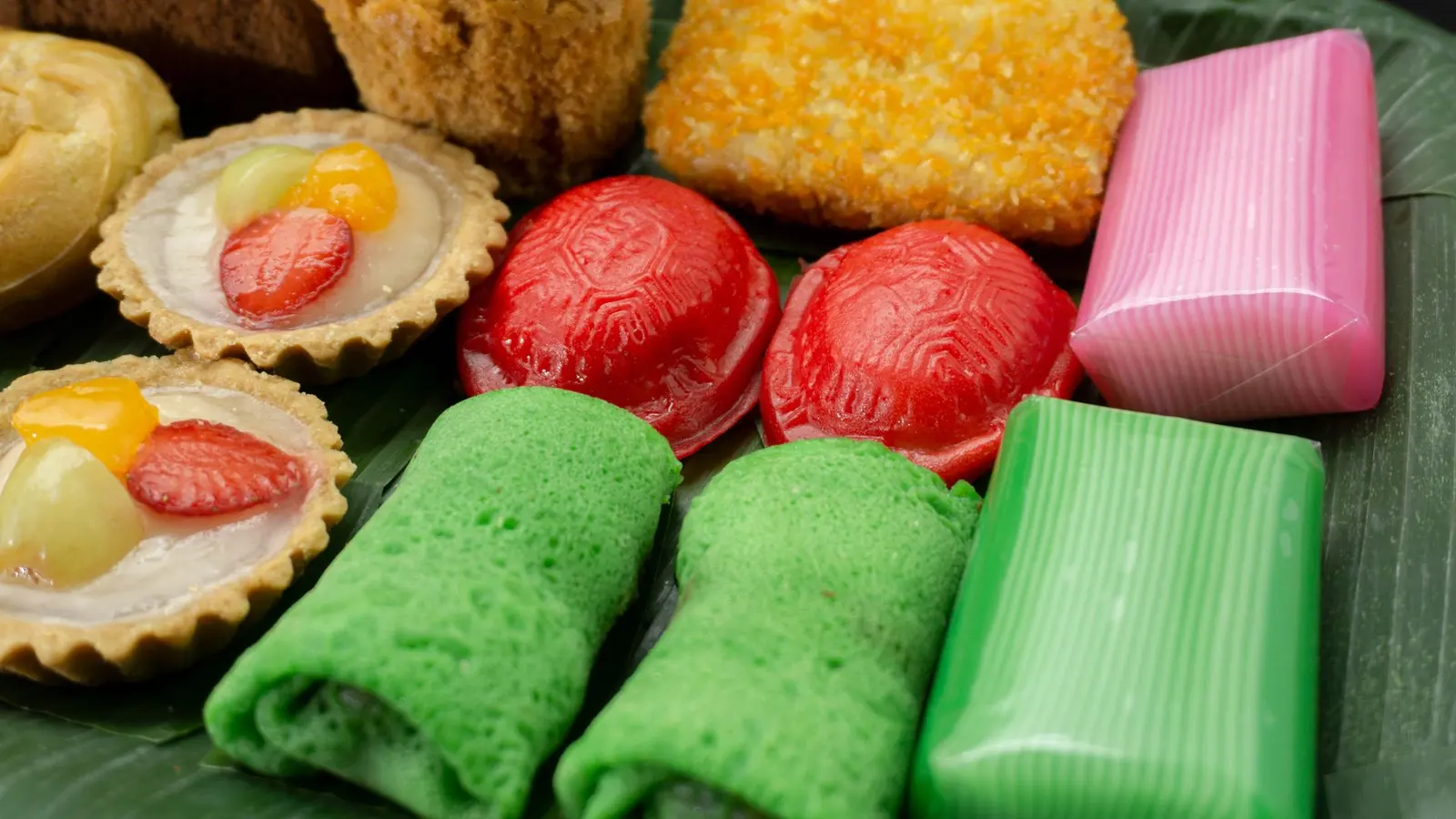
Ang ku kueh means "red tortoise cake" in Hokkien. It is a small oval cake with a thin, chewy skin made from glutinous rice flour, wrapped around a sweet filling. A wooden mould presses a tortoise-shell pattern onto the top. The red colour stands for joy and good fortune, and the tortoise stands for long life.
In Singapore the cake belongs to both Hokkien and Peranakan kitchens. Families buy it for a baby's first month, for elders' birthdays and to offer at temple altars. Neighbourhood kueh shops still steam it fresh every morning. Mung bean and peanut are the classic fillings, and newer flavours such as durian and yam now sit next to them. This recipe makes 12 cakes.
Ingredients
For the mung bean filling
- 200 g split, skinned mung beans (yellow, sold in packets at supermarkets and dry-goods stalls)
- 90 g white sugar
- 3 tbsp vegetable or peanut oil
- 1 pinch salt
For the peanut filling (instead of mung bean)
- 200 g roasted peanuts, skins removed
- 80 g white sugar, or 60 g sugar plus 20 g grated gula melaka
- 2 tbsp toasted white sesame seeds
- 2 tbsp vegetable oil
- 1 pinch salt
For the skin
- 150 g orange sweet potato, peeled and cut into chunks
- 250 g glutinous rice flour, plus 2 tbsp for dusting
- 30 g white sugar
- 2 tbsp vegetable oil
- 120 to 160 ml warm water
- 1/4 tsp red gel food colouring, or a few drops of liquid red colouring
To assemble
- 12 pieces banana leaf, each about 7 cm x 9 cm (wet markets sell leaves by the bundle). Baking paper cut to the same size works too.
- 1 tbsp oil for brushing
- 1 ang ku kueh mould, wooden or plastic (sold at baking supply shops). Without one, shape the cakes by hand into flat ovals.
Method
- Rinse the mung beans until the water runs clear, then soak them in cold water for 3 hours. Drain well.
- Spread the beans on a heatproof plate and steam over high heat for 25 minutes, until they crush easily between two fingers.
- Mash the hot beans to a smooth paste with a fork or a food processor.
- Heat the oil in a non-stick pan over medium-low heat. Add the mashed beans, sugar and salt.
- Stir constantly for 10 to 12 minutes, until the paste pulls away from the pan and holds its shape. Cool completely.
- For peanut filling instead: blitz the peanuts and sugar in a food processor until coarse and sandy, about 20 seconds. Stir in the sesame, oil and salt. The mix should clump when you squeeze it.
- Divide the cooled filling into 12 balls of about 25 g each. Chill them while you make the skin.
- Steam the sweet potato over high heat for 15 minutes, until soft. Mash it smooth while hot.
- In a large bowl, mix the flour and sugar. Add the warm mashed sweet potato, the oil and the colouring.
- Add 120 ml warm water and knead for 5 minutes. Add the rest of the water a spoonful at a time, until the dough is soft and smooth and no longer cracks at the edges.
- Divide the dough into 12 pieces of about 45 g each.
- Flatten one piece into a disc about 8 cm across, a little thicker in the middle. Put a filling ball in the centre and pinch the dough closed over it. Roll it gently into a smooth ball.
- Dust the mould lightly with glutinous rice flour and tap out the excess.
- Press the ball into the mould, seam side up, and flatten it so it fills the pattern.
- Knock the mould firmly on the table to release the cake. Set it on an oiled banana leaf. Repeat with the rest.
- Bring a steamer to a boil, then turn the heat down to medium.
- Steam the cakes, spaced apart, for 8 to 10 minutes. Wrap the steamer lid in a cloth so drips do not blur the pattern.
- Brush each cake lightly with oil straight after steaming so it stays shiny and soft. Cool for 10 minutes before eating.
Tips
- Make the filling a day ahead and keep it covered in the fridge. Filling made the same day must be fully cool before you wrap it.
- If the dough sticks to the mould, it is too wet. Knead in a little more flour, and dust the mould before every cake.
- Keep the steamer at medium. Strong heat makes the cakes puff up and lose the tortoise pattern.
- Ang ku kueh is best eaten the day you make it. Keep it covered at room temperature for up to one day.
- Chilled cakes turn hard. Re-steam them for 3 to 4 minutes and they will soften again.
- The sweet potato keeps the skin soft for longer than flour and water alone. Pumpkin works the same way.
Where to eat it in Singapore
- Ji Xiang Ang Ku Kueh, 1 Everton Park, #01-33. A long-running shop near Outram Park known for its handmade kueh, with peanut, sweet bean, black sesame and durian fillings. Open Monday to Saturday, 8am to 4.30pm, according to Eatbook's October 2026 guide.
- 146 Famous Bukit Merah Ang Ku Kueh, Block 146 Jalan Bukit Merah. A void-deck shop with more than ten flavours, including peanut, mung bean, yam and sweet corn. Open daily, 7.30am to 7pm, according to Eatbook's October 2026 review.
Hours change, especially around public holidays and festivals, so check before you go.
The story
The cake comes from southern Fujian in China, from around Xiamen, Quanzhou and Zhangzhou, and travelled to Southeast Asia with Hokkien migrants. In old China, tortoises were offered to the gods as a wish for long life. Moulded tortoise cakes later replaced the live animals. Today Singapore families still give red ang ku kueh for a baby's first month and for elders' birthdays, and offer it at altars during Chinese New Year and the Jade Emperor's birthday, often in sets of 12. The National Heritage Board's Kueh entry says black versions are made for the Hungry Ghost Festival and for death anniversaries. The Peranakan Museum holds a wooden ang ku kueh mould from the early 20th century, made in Singapore and British Malaya.
Last updated 25 Nov 2026 · Checked against official sources on 25 Nov 2026