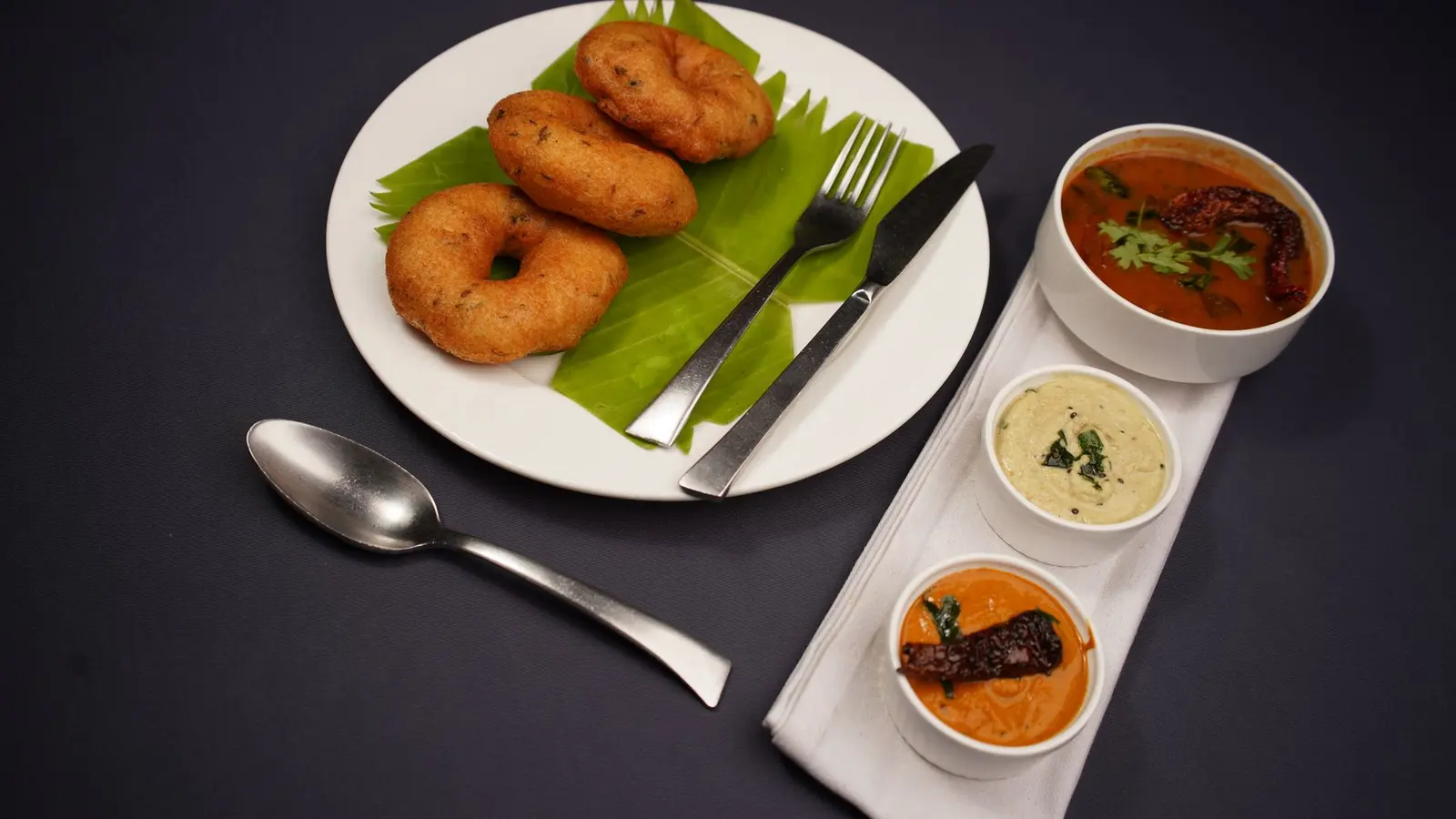
Vadai are deep-fried fritters made from soaked, ground lentils. They are crisp outside and soft inside, and spiced with onion, green chilli, ginger and curry leaves. They are an Indian snack, but in Singapore they are also sold at Malay stalls, night markets and Ramadan bazaars, where people often call them vadeh or wadeh. The local favourite is prawn vadai: a fritter with a whole prawn pressed on top, fried until the shell is crunchy enough to eat.
This recipe makes a light dough from two kinds of dal. You can fry it plain, or top half the batch with prawns. Eat them hot, the way stalls serve them, with a fresh green chilli on the side.
Ingredients
For the dough
- 200 g urad dal (skinned split black gram, sold as white urad dal)
- 100 g chana dal (split Bengal gram); yellow split peas work as a substitute
- 1 medium red onion (about 120 g), finely chopped
- 2 green chillies, finely chopped
- 15 g ginger, finely chopped
- 2 sprigs curry leaves, leaves torn (leave them out if you cannot find any)
- 1 tsp fennel seeds
- 1 tsp salt
- 2 tbsp rice flour
- 1/4 tsp baking soda
- 2 to 4 tbsp cold water, only as needed
For the prawn topping (optional)
- 16 small grey or white prawns (about 200 g), heads and legs trimmed, shells left on
- 1/4 tsp ground turmeric
- A pinch of salt
- Substitute: thawed frozen peeled prawns, or a few ikan bilis (dried anchovies) pressed into each fritter
To fry and serve
- About 1 litre vegetable or peanut oil
- Fresh green chillies and sliced onion, to serve
Urad dal, chana dal, fennel seeds and curry leaves are sold at Indian grocers and many supermarkets. Curry leaves and small prawns are easy to find at wet markets.
Method
- Rinse the urad dal and chana dal separately until the water runs clear. Soak each in its own bowl of cold water for 4 hours.
- Drain both dals very well in a sieve for 10 minutes. Too much water gives flat, oily fritters.
- Blend the urad dal with 2 tbsp cold water until smooth and fluffy, about 3 minutes. Scrape down the sides as you go. Add more water a spoonful at a time only if the blades stop turning.
- Pulse the chana dal with no water until it looks like coarse crumbs. Some texture is good.
- In a large bowl, mix the urad paste, chana dal, onion, green chilli, ginger, curry leaves, fennel seeds, salt, rice flour and baking soda. Beat with your hand or a spoon for 1 minute to trap air.
- If you are using prawns, toss them with the turmeric and a pinch of salt. Set aside.
- Heat the oil in a wok or deep pot over medium heat to about 170 to 175 °C, which takes about 8 minutes. To test, drop in a pea-sized bit of dough. It should rise at once and bubble steadily without browning fast.
- Wet your hands. Take a golf-ball-sized lump of dough, flatten it into a patty about 1.5 cm thick, and press a prawn firmly into the top. For plain vadai, push a hole through the centre with your thumb so it cooks evenly.
- Slide 4 or 5 patties into the oil, one at a time. Do not crowd the pot.
- Fry for 4 to 5 minutes, turning once, until deep golden brown all over and the prawn shells are crisp.
- Lift them out with a slotted spoon and drain on a rack or kitchen paper.
- Let the oil come back to temperature for 1 minute, then fry the next batch. Repeat until the dough is used up. You should get about 16 fritters.
Tips
- Keep the dough thick. If it is runny, stir in another tablespoon of rice flour rather than frying it as it is.
- Do not add the salt and onion hours ahead. They draw water out and the dough slackens. Mix them in just before frying.
- Oil that is too hot browns the outside before the middle cooks. Oil that is too cool makes the fritters greasy. Adjust the heat between batches.
- Make ahead: the plain ground dal (with no salt or onion) keeps for 1 day in the fridge.
- Storage: cooked vadai keep for 2 days in an airtight box in the fridge. Reheat in a 180 °C oven or air fryer for 5 to 6 minutes to bring back the crunch. The microwave makes them soft.
- Vadai go soft as they cool, so serve them within 15 minutes of frying.
Where to eat it in Singapore
The Original Vadai is the name most people know for prawn vadai. It grew from a family stall at night markets and bazaars, and its own website now lists several outlets. Its online menu prices a prawn vadai at S$1.60 and a vegetable vadai at S$1.50. Other flavours include ikan bilis, onion and dhal.
- The Original Vadai, Golden Mile Food Centre: 505 Beach Road, #B1-32. The website lists it as open Tuesday to Sunday, 9am to 7.45pm. This was the brand's first permanent outlet, opened in 2020.
- The Original Vadai, Geylang Serai Market and Food Centre: 1 Geylang Serai, #02-166. The website lists it as open Tuesday to Sunday, 8am to 3.45pm. Handy if you are visiting the market.
- The Original Vadai, Joo Chiat: 82 Joo Chiat Road, #01-01. The website lists it as open daily from 10am. Good for a snack on a walk around the Katong and Joo Chiat shophouses.
Outlet hours come from the brand's website. Check before you make a special trip, as stall hours can change.
The story
Vadai came to Singapore with South Indian migrants, and the prawn-topped version became a local favourite at night markets and Hari Raya bazaars. Food writer KF Seetoh reported in Makansutra that one vadai-making family says Singapore-style prawn vadai was sold in Farrer Park as early as the 1950s. He also said he could not verify the claim. In a 2022 gov.sg profile, Stephen Suriyah, owner of The Original Vadai, tells how his mother made a lighter, fluffier prawn vadai and sold it at Ramadan bazaars from the late 1980s. He took over the family business at 18 and opened its first permanent outlet at Golden Mile Food Centre in April 2020.