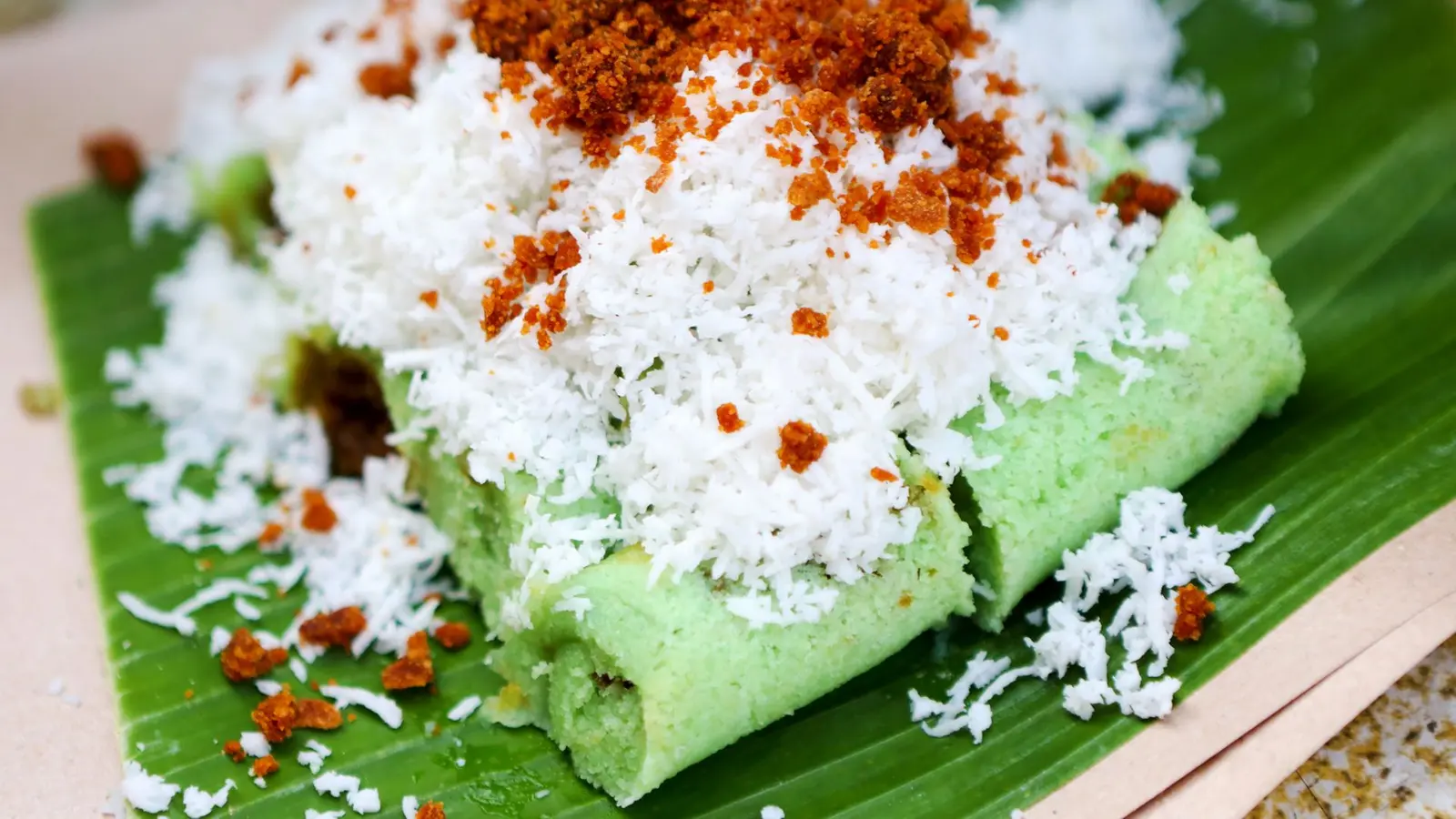
Putu mayam is a tangle of thin rice-flour strands, steamed until soft and served with freshly grated coconut and sugar. It looks like a small nest of vermicelli. In Singapore people usually eat it for breakfast or as a mid-morning snack, and it often turns up at Deepavali, Hari Raya and family celebrations.
The dish comes from South India, where similar string hoppers are eaten. Singapore's version has its own habits. It is eaten sweet, with coconut and brown sugar or gula melaka. It is sold at Indian and Indian Muslim hawker stalls across the island and is a favourite with every community. This recipe uses ingredients from any NTUC FairPrice, Sheng Siong or wet market. For the press, try the kitchenware shops in Little India.
Ingredients
For the strings
- 250 g rice flour (idiyappam or "string hopper" flour if you can find it, which is already roasted)
- 1 pandan leaf, cut into 3 pieces (optional, for roasting the flour)
- 1/2 tsp fine salt
- 300 to 350 ml boiling water
- 1 tsp vegetable oil, plus extra for greasing
For serving
- 150 g fresh grated white coconut (from the wet market coconut stall, or chilled packs at the supermarket)
- 1 pinch salt
- 80 g brown sugar, or 80 g gula melaka shaved or finely chopped
Equipment and substitutes
- An idiyappam (string hopper) press with the fine-hole disc. If you have no press, use a sturdy piping bag with a 2 to 3 mm round nozzle or a potato ricer. The strands will be thicker, but they still taste good.
- A steamer, plus a few banana leaf squares or small greased plates. Greased baking paper works too.
- If you cannot get fresh coconut, use 100 g of unsweetened desiccated coconut. Sprinkle it with 3 tbsp of warm water and leave it for 10 minutes before you use it.
Method
- Dry-roast the rice flour with the pandan leaf in a wide pan over low heat for 5 to 7 minutes. Stir all the time. Stop when the flour flows freely and smells toasty but is still white. Skip this step if your flour is already roasted.
- Take out the pandan leaf. Tip the flour and the salt into a heatproof bowl and leave it to cool for 5 minutes.
- Stir in the oil, then pour in 300 ml of the boiling water a little at a time. Mix with a wooden spoon or chopsticks as you go.
- Once the mixture is cool enough to touch, knead it for 2 to 3 minutes into a soft, smooth dough that does not stick. If it cracks, add more hot water a spoonful at a time.
- Cover the dough with a damp cloth and let it rest for 10 minutes.
- Mix the grated coconut with the pinch of salt. Steam it over high heat for 5 minutes so it keeps longer, then leave it to cool.
- Bring water in the steamer to a rolling boil over high heat. Grease the banana leaf squares or plates.
- Fill the press with dough. Press it out in a circular motion onto each square to make flat, lacy nests about 10 cm across, one or two layers thick.
- Steam the nests over high heat for 6 to 8 minutes, until the strands look slightly shiny and feel soft. Do not let them go mushy.
- Lift them out and let them cool for 2 minutes. Repeat with the rest of the dough, keeping it covered between batches.
- To serve, put two or three nests on a plate or banana leaf. Top with plenty of grated coconut and a spoonful of brown sugar or gula melaka, then eat with your fingers.
Tips
- Hot water matters. Cold or warm water gives a crumbly dough that breaks in the press.
- If the press is very hard to push, the dough is too dry. If the strands stick together in a lump, it is too wet. Fix it with a spoonful of hot water or a sprinkle of flour.
- Make ahead: the steamed nests keep in an airtight box in the fridge for 2 days. Steam them again for 2 to 3 minutes before serving.
- Fresh grated coconut goes sour fast in Singapore's heat. Steam it as in step 6, keep it in the fridge and use it within a day.
- Keep the sugar on the side if you are not serving at once, so the strings do not go soggy.
- Leftover nests can be fried with egg, onion and chilli for a savoury breakfast.
Where to eat it in Singapore
- ThatPutuMayamStall, #02-20 Bukit Merah Central Food Centre, 163 Bukit Merah Central. This stall sells only putu mayam. Eatbook (March 2024) listed it as open Tuesday to Saturday, 7am to 1.30pm, at SGD 2 a packet.
- Mum Mum 31, #01-50 Alexandra Village Food Centre, 120 Bukit Merah Lane 1. Eatbook (June 2026) found original putu mayam for SGD 2.50 and an onde-onde version for SGD 3.20. Opening hours had not been fixed at the time, so check before you go.
Freshly made putu mayam sells out early. Go in the morning, and expect prices to have changed since these reviews.
The story
According to SG101, putu mayam has been sold in Singapore since at least the 1920s. Back then, street hawkers carried it in baskets on their heads and wrapped each portion in newspaper. It used to come with small blocks of gula melaka, not the granulated sugar common today. "Putu" means rice cake in Malay, and "mayam" may come from "mayang", a word for grated coconut. The Indian Muslim community helped make the dish popular during Ramadan and Malay festivities, and it is still served at Deepavali and Indian weddings. The National Heritage Board's Roots entry on kueh tutu says the Malay putu piring is believed to have grown out of the South Indian putu mayam, and that both often appear at Hari Raya Puasa, Deepavali, weddings and birthdays. SG101 notes that few stalls still make putu mayam from scratch.