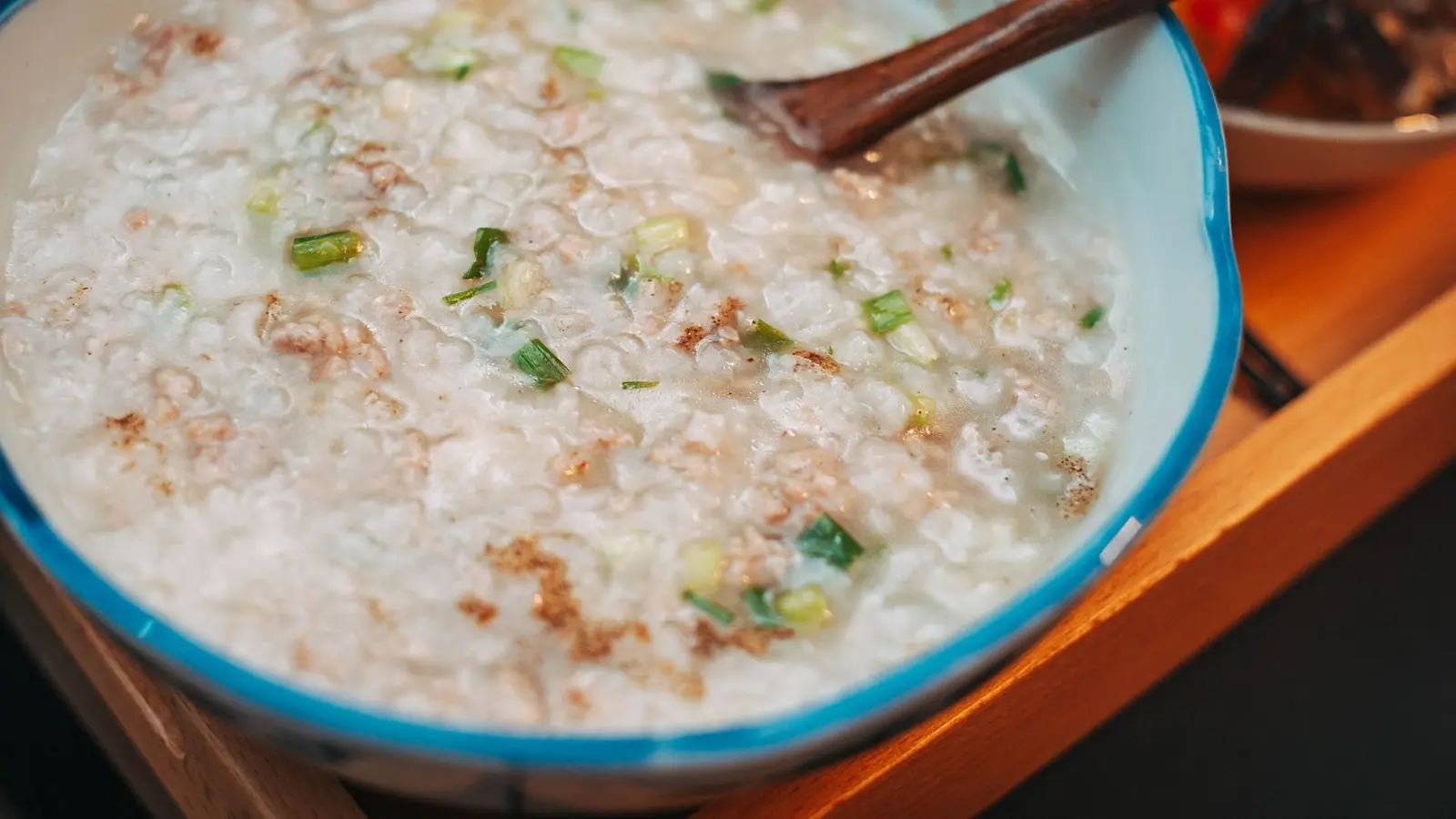
Teochew porridge, which Teochew speakers call muay, is plain rice cooked in a lot of water. The grains go soft but stay whole, and they sit in a thin, clear liquid. It is not a thick congee. The porridge has almost no flavour of its own because the side dishes do that work. Salty, sweet and savoury small plates go around the table, and everyone eats from them between spoonfuls of bland rice.
In Singapore it is comfort food at home and a favourite late-night meal at porridge stalls, where you choose from a long row of dishes. This recipe sticks to three simple sides that keep well: salted duck eggs, peanuts braised in soy sauce, and chye poh (preserved radish) fried until sticky. You can find everything at FairPrice, Sheng Siong or a wet market dry-goods stall.
Ingredients
For the porridge
- 200 g jasmine rice (Thai fragrant rice)
- 2.5 litres water, plus a kettle of hot water to loosen the pot later
For the braised peanuts
- 200 g raw shelled peanuts with skins on, soaked overnight
- 1 litre water
- 3 tbsp light soy sauce
- 1 tbsp dark soy sauce
- 1 tbsp sugar (rock sugar or white sugar)
- 2 star anise
- 3 cloves garlic, lightly crushed
- Short cut: one 400 g can of braised peanuts from the canned food aisle
For the chye poh
- 80 g chopped chye poh (preserved radish). Use sweet chye poh, or salted chye poh if that is all you can find
- 2 tbsp cooking oil
- 3 cloves garlic, finely chopped
- 1 to 2 tsp sugar, adjusted to taste
- 1 fresh red chilli, sliced (optional)
For the salted eggs
- 4 salted duck eggs. Packs of raw ones are sold in supermarkets and wet markets. Some shops also sell them ready-cooked
Method
- The night before, rinse the peanuts and leave them to soak in plenty of cold water.
- Drain the peanuts and put them in a pot with 1 litre water, both soy sauces, sugar, star anise and garlic. Bring to a boil over high heat.
- Lower the heat to a gentle simmer, cover and cook for about 1 hour until the peanuts are soft all the way through. Check one at 45 minutes. Add hot water if the liquid drops below the peanuts.
- While the peanuts cook, put the raw salted eggs in a small pot, cover with cold water and bring to a boil over medium-high heat. Boil for 10 minutes, then drain. Skip this step if your eggs are already cooked.
- Put the chye poh in a bowl of water for 5 minutes, then drain and squeeze it dry. Salted chye poh needs 10 to 15 minutes and one change of water.
- Heat the oil in a wok over medium-low heat. Fry the garlic for about 1 minute until pale gold.
- Add the chye poh and stir-fry for 5 to 7 minutes until it smells toasty and the edges darken a little.
- Stir in the sugar, plus the chilli if you are using it, and fry for 1 more minute until glossy. Taste and add more sugar if it is too salty. Spoon it into a dish.
- About 30 minutes before you want to eat, rinse the rice two or three times in cold water until the water runs mostly clear. Drain.
- Bring 2.5 litres water to a full boil in a large pot over high heat. Add the rice and stir once so it does not stick to the bottom.
- Once it boils again, turn the heat down to medium so the pot bubbles steadily without boiling over. Cook uncovered for 20 to 25 minutes and stir now and then. It is ready when the grains are swollen and soft, a few have split, and they still float in plenty of thin liquid.
- Turn off the heat. If the porridge has thickened, stir in a little hot water from the kettle.
- Peel the salted eggs and cut them in half lengthwise, or into quarters.
- Put the porridge in bowls, set the eggs, peanuts with a little of their braising liquid, and chye poh in the middle of the table, and let everyone help themselves.
Tips
- Make ahead: The peanuts taste better the day after you cook them. Keep them covered in their liquid in the fridge for up to 4 days. Fried chye poh keeps for about a week in a clean, airtight jar in the fridge.
- Cook the porridge last: The rice keeps soaking up water as it sits, so it goes thick and loses the watery texture this style is known for. Cook it just before serving.
- Do not over-stir: Stir too hard or too often and the grains break up, which gives you starchy congee.
- Salt control: Salted eggs, soy and chye poh are all salty. Do not add salt to the porridge.
- Leftover porridge: Loosen it with hot water and reheat it gently in a pot. It will be softer than when freshly cooked.
- Easy extras: Blanched greens with oyster sauce, a chye poh omelette, or store-bought fish cake round out the meal.
Where to eat it in Singapore
Hours change often, and the listings below do not always agree. Check before you go.
- Teo Heng Teochew Porridge, Amoy Street Food Centre, 7 Maxwell Road, #01-27. A long-running heritage stall. In a May 2026 review it is listed as open for breakfast and lunch from Monday to Thursday only.
- Choon Seng Teochew Porridge, 43 Cambridge Road, near Farrer Park. This stall has operated since before the Second World War and moved to its current site in 1998. Recent listings agree it opens Monday to Saturday from 10am for lunch. Do not count on an evening session.
- Ye Lai Xiang Teochew Porridge, 116 Bukit Merah View, #01-217. A listing from April 2026 gives its hours as daily from 10am to 4am, so it works for supper.
- Joo Seng Teochew Porridge, 14 Cheong Chin Nam Road, near Beauty World. A late-night stop, listed in 2025 as open daily from 9:30am to 4am.
The story
Most Teochew families in Singapore have roots in the Chaoshan region of eastern Guangdong. Many came south after Shantou opened as a trading port in 1860. The Singapore Chinese Cultural Centre's Culturepaedia says the earliest Teochew arrivals lived on simple bowls of muay with chye poh and other preserved foods. In Chaoshan the porridge came with braised goose, cured seafood and pickles. A Roots article by the National Heritage Board explains that in Singapore the spread was simplified. Many stalls came to be run by cooks who were not Teochew, and they added home-style dishes from other Chinese groups, such as Cantonese sweet and sour pork and Hakka braised pork belly. The writer suggests that "Teochew-style porridge with Southern Chinese dishes" is a more accurate name for what Singapore stalls serve today.