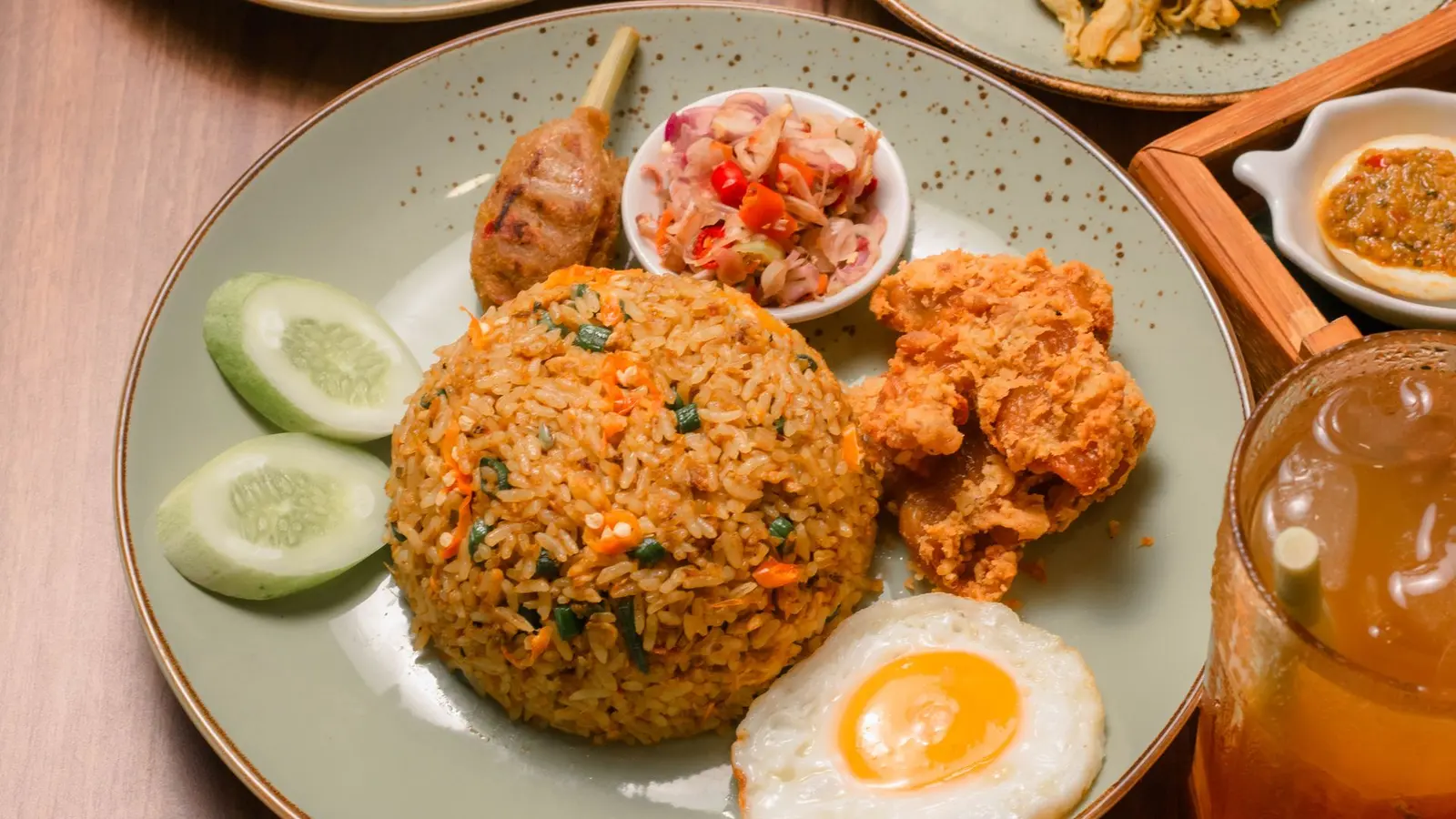
Nasi goreng kampung is the plain, punchy kind of Malay fried rice. You fry day-old rice in a pounded paste of shallots, garlic, chilli and belacan, then toss it with kangkong and crisp ikan bilis. There is no ketchup and no sweet soy glaze. What gives it flavour is the smoky, salty paste and a lot of heat from the wok.
In Singapore you will see it on the menu at Malay and Muslim food stalls in hawker centres, often next to other fried rice styles. Everything in it is cheap and easy to find here. Kangkong, dried anchovies and blocks of belacan are sold in neighbourhood supermarkets and wet markets across the island.
Ingredients
For the rice
- 600 g cooked jasmine rice, cooked the day before and chilled (about 300 g raw rice)
- 200 g kangkong (water spinach), about 1 bunch
- 2 large eggs
- 1 tbsp light soy sauce
- 1/2 tsp salt, plus more to taste
- 1/2 tsp sugar
- 3 tbsp cooking oil
For the ikan bilis
- 40 g dried ikan bilis (small anchovies), heads and dark gut removed
- 4 tbsp cooking oil
For the chilli paste
- 6 shallots (about 60 g), peeled
- 4 cloves garlic, peeled
- 2 fresh red chillies, deseeded if you want it milder
- 3 to 5 chilli padi (bird's eye chillies), to taste
- 10 g belacan (shrimp paste), about 1 heaped tsp
To serve
- 1 small cucumber, sliced
- 1 lime or 2 limau kasturi (calamansi), halved
- 2 extra fried eggs (optional)
Substitutes
- No kangkong: use spinach, chye sim or long beans cut into short pieces.
- No belacan: use 2 tsp fish sauce, added with the soy sauce.
- No ikan bilis: use 2 tbsp dried shrimp, soaked for 10 minutes and chopped, or skip and add a little more salt.
- No mortar and pestle: blend the paste ingredients with 1 tbsp oil in a small blender.
Method
- Rinse the ikan bilis quickly in a sieve and pat completely dry with kitchen paper.
- Wash the kangkong. Cut the stems into 3 cm pieces and keep the leaves separate.
- Wrap the belacan in a small piece of foil and toast it in a dry pan over medium heat for 2 minutes per side, until it smells roasted.
- Pound or blend the shallots, garlic, red chillies, chilli padi and toasted belacan into a rough paste.
- Break up the cold rice with your fingers so there are no clumps.
- Heat 4 tbsp oil in a wok over medium heat. Fry the ikan bilis for 3 to 4 minutes, stirring, until golden and crisp. Lift out onto kitchen paper.
- Pour off all but 3 tbsp oil. Over medium-low heat, fry the chilli paste for 4 to 5 minutes, stirring often, until it darkens and the oil starts to separate.
- Turn the heat to high. Add the kangkong stems and stir-fry for 1 minute.
- Push everything to one side. Crack the 2 eggs into the empty space and scramble for 30 seconds until just set.
- Add the rice. Toss and press it against the wok for 3 to 4 minutes on high heat, until every grain is coated and hot.
- Season with the soy sauce, salt and sugar. Toss for 1 more minute.
- Add the kangkong leaves and half the ikan bilis. Toss for 30 to 60 seconds, just until the leaves wilt.
- Taste and adjust salt. Plate with cucumber, lime, a fried egg if you like, and the rest of the ikan bilis on top.
Tips
- Use rice cooked the day before. Freshly cooked rice is too wet and turns mushy.
- Fry the ikan bilis first and add most of it at the end so it stays crunchy.
- Do not crowd the wok. If yours is small, fry the rice in two batches.
- Toasting belacan gives off a strong smell. Open a window or turn on the hood.
- You can make the chilli paste ahead. It keeps in a sealed jar in the fridge for up to 5 days.
- Leftover fried rice keeps in the fridge for 1 day. Reheat it in a hot pan until steaming, and store the ikan bilis separately so it stays crisp.
Where to eat it in Singapore
Opening hours and prices below come from a January 2026 hawker review. Check before you go, since stalls change hours.
- Hass Bawa, Marine Parade Central Market and Food Centre, 84 Marine Parade Central, #01-39, Singapore 440084. Long-running nasi goreng stall that started in 1978. Open Saturday to Thursday, 11am to 8.30pm, closed Friday. Nasi goreng was SGD 6.
- Farasha, Seah Im Food Centre, 2 Seah Im Road, #01-31, Singapore 099114. Has a nasi goreng kampung on its menu. Open Monday to Saturday, 8am to 8pm, closed Sunday. Nasi goreng was SGD 10.50.
- N.M. Abdul Rahim, Ayer Rajah Food Centre, 503 West Coast Drive, #01-60. Running since 1990, with a kampung-style fried rice. Open daily, 10.30am to 11.50pm. Nasi goreng was SGD 9.70.
The story
The word kampung (also spelt kampong) means village, and the name points to home cooking from the days when many Malays in Singapore lived in villages. The National Heritage Board's Roots entry on Malay cuisine notes that many Malays were once seafaring people who ate a lot of seafood. It lists belacan among the core ingredients of Malay cooking and names fried anchovies as a standard part of nasi lemak. The same entry says Malay food here has absorbed ideas from other communities over time. Nasi goreng kampung uses the same pantry: rice, dried anchovies, shrimp paste and chilli, fried together in one wok.