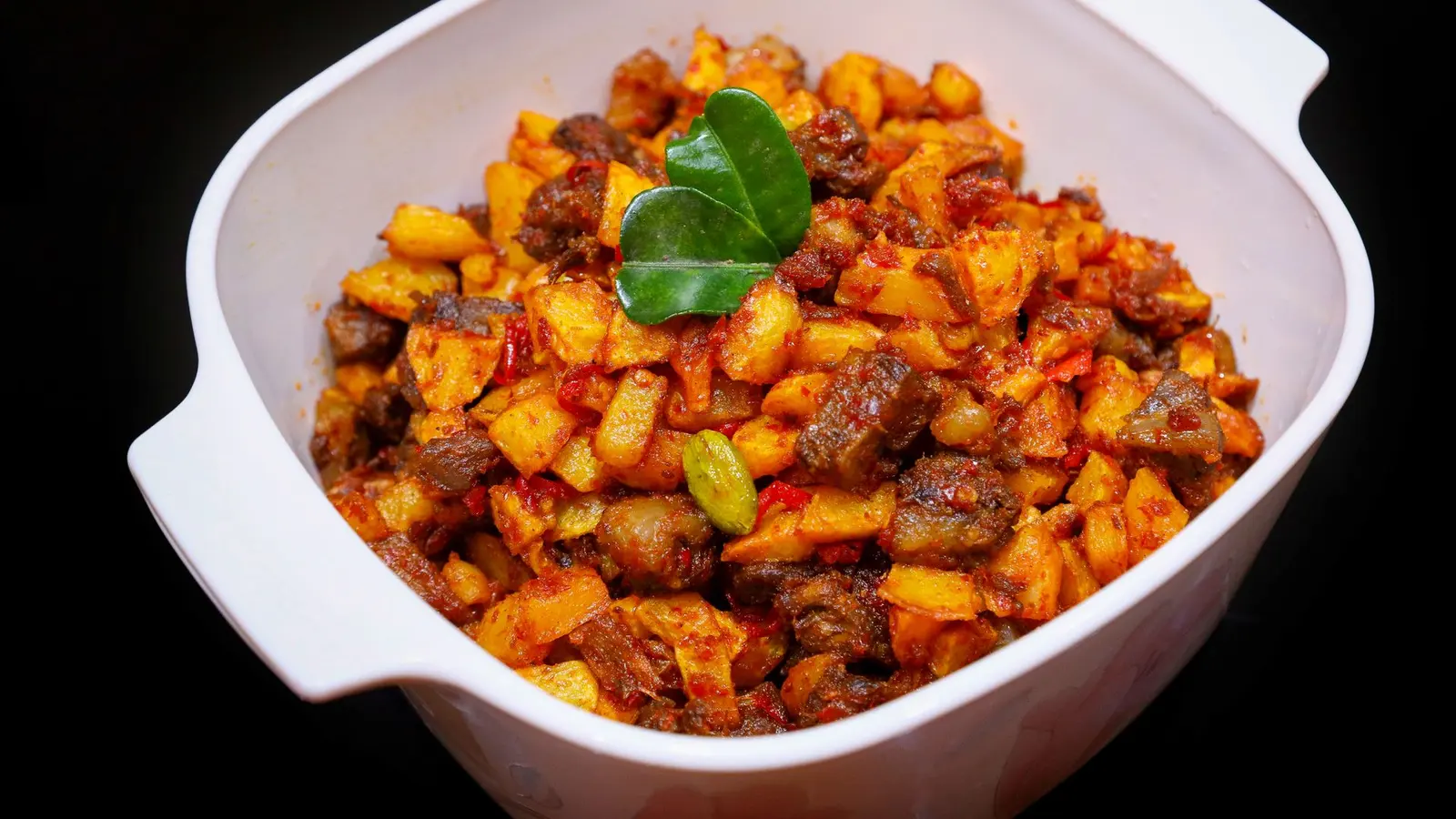
Mee goreng mamak is a plate of yellow wheat noodles fried hard in a hot wok with chilli, tomato ketchup, soy sauce, potato, fried tofu, egg and bean sprouts. It comes out red, a little sweet, a little sour and quite spicy, and it is finished with a squeeze of lime at the table. In Singapore it is cooked at Indian-Muslim stalls in hawker centres and at 24-hour eateries, where it is a favourite late-night supper.
The dish is a good picture of how food mixes in Singapore. The noodles are Chinese, the ketchup is Western, the spices and chilli come from Indian and Malay cooking, and the dish itself took shape here, not in India. This version is written for a home stove and uses only things you can find at a supermarket or wet market.
Ingredients
For the chilli paste
- 12 dried red chillies, snipped into pieces and soaked in hot water for 15 minutes (or 3 tbsp ready-made chilli paste)
- 5 shallots, peeled
- 4 cloves garlic, peeled
- 2 tbsp water
For the sauce
- 4 tbsp tomato ketchup
- 2 tbsp bottled chilli sauce
- 1 tbsp light soy sauce
- 1 tbsp dark soy sauce
- 1 tsp meat curry powder
- 1 tsp sugar
- 4 tbsp water
For the noodles
- 500 g fresh yellow noodles (yellow mee), from the chiller section
- 2 medium potatoes (about 300 g)
- 1 block firm tofu (tau kwa, about 200 g)
- 150 g bean sprouts, tails picked off if you have time
- 100 g choy sum, cut into 4 cm lengths
- 2 eggs
- 1 medium tomato, cut into 8 wedges
- 150 g peeled prawns or thinly sliced chicken (optional)
- 6 tbsp cooking oil
- Salt to taste
To serve
- 4 calamansi limes (limau kasturi), halved, or 1 regular lime cut into wedges
- 2 green chillies, sliced
- 2 tbsp fried shallots
Substitutes: if you cannot find fresh yellow noodles, boil 250 g dried egg noodles until just tender, rinse in cold water and drain well. Any firm tofu works in place of tau kwa. Kai lan or cabbage can replace choy sum. Chicken curry powder is fine if you do not have meat curry powder.
Method
- Peel the potatoes, put them whole in a pot of salted water and boil over medium-high heat for 15 to 20 minutes, until a knife slides in easily. Drain, cool for 5 minutes, then cut into 2 cm cubes.
- While the potatoes boil, drain the soaked chillies and blend them with the shallots, garlic and 2 tbsp water into a smooth paste.
- Stir all the sauce ingredients together in a small bowl.
- Rinse the yellow noodles in a colander under the tap for a few seconds to remove the excess alkaline taste, then shake dry.
- Pat the tofu dry and cut it into 2 cm cubes.
- Heat 3 tbsp oil in a wok over medium-high heat. Fry the tofu for 5 to 6 minutes, turning, until golden on most sides. Lift out and set aside.
- Add the potato cubes to the same oil and fry for 3 to 4 minutes until the edges colour. Lift out and set aside.
- Add the remaining 3 tbsp oil and the chilli paste. Fry over medium heat for 6 to 8 minutes, stirring often, until it darkens and the oil starts to separate from the paste.
- If using prawns or chicken, add them now and stir-fry for 2 to 3 minutes until just cooked.
- Push everything to one side, crack the eggs into the empty space and scramble them for 30 seconds until half set.
- Turn the heat to high. Add the noodles and the sauce and toss for 2 minutes so every strand is coated and red.
- Add the choy sum, tomato wedges, fried tofu and potato. Toss for 2 minutes, pressing some potato pieces lightly so they break and cling to the noodles.
- Add the bean sprouts and toss for 30 seconds only, so they stay crunchy. Taste and add a pinch of salt or sugar if needed.
- Plate at once. Top with fried shallots and green chilli, and serve with lime halves to squeeze over.
Tips
- Your wok will crowd with 500 g of noodles. If it is small, fry in two batches and split the paste and sauce in half.
- Make the chilli paste ahead. It keeps for a week in a closed jar in the fridge, or a month in the freezer.
- Boil and cube the potatoes the day before to cut prep time.
- Do not drown the noodles in sauce. Hawker mee goreng is fairly dry; a wet plate turns soft and mushy.
- Leftovers keep in the fridge for up to 2 days. Reheat in a hot wok with a splash of water rather than in the microwave.
- Want it less spicy? Use 6 dried chillies and a little more ketchup.
- The bright red colour at many stalls comes from chilli and sambal fried into the noodles. You do not need food colouring at home.
Where to eat it in Singapore
- N.M. Abdul Rahim, Ayer Rajah Food Centre, 503 West Coast Drive, #01-60. A family stall that began as a pushcart at Shenton Way and is known for its fiery red mee goreng, listed at S$4.50 a plate in a November 2025 review.
- Hass Bawa, Marine Parade Central Market and Food Centre, 84 Marine Parade Central, #01-39. A long-running stall often named among the best mee goreng in Singapore, listed at S$5 a plate in an August 2025 review. Closed on Thursdays.
Hawker hours change, so check before making a special trip.
The story
Mee goreng means "fried noodles" in Malay, but the version sold at Indian-Muslim stalls is very much a Singapore and Malaysia creation. The National Library Board's BiblioAsia magazine describes it as a hybrid dish that may have started as an Indian take on Chinese fried noodles such as char kway teow. It credits the Tamil-Muslim Chulia community, who came from Madras (now Chennai), with making it popular, which is why it is still linked to Indian-Muslim cooks. A later BiblioAsia article notes that the dish did not come from India and that early Indian-Muslim hawkers sold it from woks mounted on tricycles, long before it became a supper staple at round-the-clock eateries.