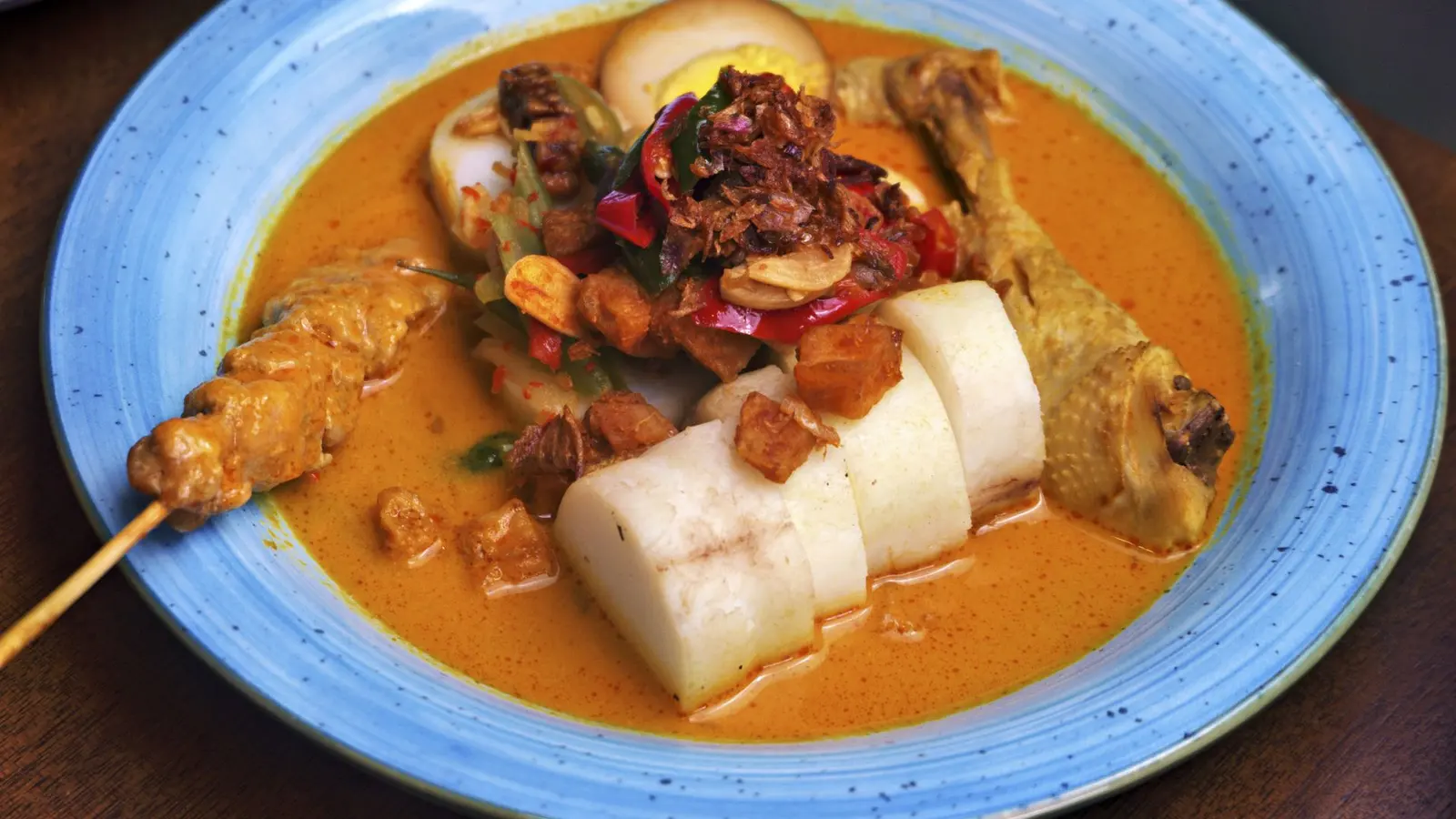
Lontong is rice packed tightly and cooked until it sets into a firm cake. You cut it into cubes and serve it in sayur lodeh, a mild curry of vegetables simmered in spices and coconut milk. Each bowl gets a spoonful of sambal and half a hard-boiled egg. Tofu and tempeh add body to the curry.
In Singapore, lontong is mostly a Malay breakfast and brunch dish. Hawker stalls often sell it alongside mee rebus and mee soto, and many close by lunchtime. It is also a favourite at Hari Raya open houses. This home version swaps the banana-leaf parcels for a pan of pressed rice, so you need no special equipment.
Ingredients
For the pressed rice (nasi impit)
- 400 g jasmine rice (about 2 cups)
- 1.2 litres water
- 1 tsp salt
- 1 pandan leaf, knotted (optional)
For the spice paste
- 8 shallots (about 100 g), peeled
- 4 cloves garlic
- 4 candlenuts (buah keras). Macadamia nuts work instead
- 3 cm galangal (lengkuas), sliced
- 2 cm fresh turmeric, or 1 tsp turmeric powder
- 6 to 8 dried chillies, soaked in hot water for 15 min and seeded
- 1 tbsp dried shrimp (udang kering), soaked for 10 min (optional)
- 1 tsp belacan (shrimp paste), toasted in a dry pan (optional)
For the sayur lodeh
- 3 tbsp cooking oil
- 2 stalks lemongrass, white part bruised
- 2 salam leaves, if you can find them (leave out if not)
- 750 ml water or chicken stock
- 1 chayote (labu siam, about 300 g), peeled and cut into thick sticks
- 1 carrot (about 150 g), cut into sticks
- 150 g long beans, cut into 5 cm lengths
- 250 g cabbage, cut into wide strips
- 2 pieces firm tofu (tau kwa, about 200 g), cubed and pan-fried
- 1 block tempeh (about 150 g), cubed and pan-fried
- 400 ml coconut milk (santan), fresh from the wet market or packaged
- 1.5 tsp salt, then to taste
- 1 tsp sugar
For the sambal
- 10 dried chillies, soaked and seeded
- 2 fresh red chillies
- 6 shallots
- 2 cloves garlic
- 1 tsp belacan, toasted
- 4 tbsp cooking oil
- 1 tbsp tamarind pulp (asam jawa), mixed with 3 tbsp water and strained
- 1 tbsp sugar, or gula melaka
- 0.5 tsp salt
To serve
- 4 eggs
- Fried shallots
- Crushed roasted peanuts (optional)
Method
- Rinse the rice until the water runs nearly clear. Put it in a pot with 1.2 litres of water, the salt and the pandan leaf.
- Bring to the boil over high heat. Turn the heat to low, cover and cook for 25 to 30 min, stirring now and then, until the rice is very soft and has soaked up all the water.
- Line a 20 cm square tin with baking paper or a banana leaf. Spoon in the hot rice and press it flat and hard with the back of an oiled spoon.
- Cover the rice with more paper, put a second tin or a flat plate on top and weigh it down with a few cans. Let it cool, then chill for at least 2 hours, or overnight, until firm.
- Make the spice paste: blend the shallots, garlic, candlenuts, galangal, turmeric, chillies, dried shrimp and belacan with 2 to 3 tbsp water until smooth.
- Heat 3 tbsp oil in a large pot over medium heat. Add the paste, lemongrass and salam leaves. Fry, stirring often, for 8 to 10 min until the paste darkens and the oil starts to separate.
- Pour in the water or stock and bring to the boil over high heat.
- Add the chayote and carrot. Simmer over medium heat for 8 min.
- Add the long beans, cabbage, tofu and tempeh. Simmer for 5 min more.
- Turn the heat to low and stir in the coconut milk. Add the salt and sugar. Keep it at a gentle simmer for 5 min. Do not let it boil hard. Taste and adjust the salt.
- Make the sambal: blend the chillies, shallots, garlic and belacan with a splash of water into a coarse paste.
- Heat 4 tbsp oil in a small pan over medium-low heat. Fry the paste for 12 to 15 min, stirring often, until it turns deep red and the oil rises to the top.
- Add the tamarind water, sugar and salt to the sambal. Cook for 3 min more, then take it off the heat.
- Boil the eggs for 10 min, cool them in cold water, peel and halve them.
- Turn out the pressed rice and cut it into 2 to 3 cm cubes with a wet knife.
- Put a handful of rice cubes in each bowl and ladle hot sayur lodeh over them. Top with an egg, a spoonful of sambal, fried shallots and peanuts if you like.
Tips
- Press the rice the night before. It sets better and slices cleanly when it is cold.
- Keep the heat low once the coconut milk is in. A hard boil can make it split and look oily.
- Do not overcook the cabbage and long beans. They should still have a little bite.
- The sambal keeps in a clean jar in the fridge for up to 2 weeks. Make a double batch.
- Store the leftover curry and rice cubes separately in the fridge and eat them within 2 days. Reheat the curry gently.
- Short on time? Some supermarkets and Malay provision shops sell ready-made rice cakes. You can also buy boil-in-bag rice and cook it for longer, until it packs firm.
- Leave out the dried shrimp and belacan for a vegetarian version, and use vegetable stock.
Where to eat it in Singapore
- Queenstown Lontong, Margaret Drive Hawker Centre, Blk 38A Margaret Drive, #01-27. A long-running stall that also sells mee rebus and mee soto. A May 2026 listing gives the hours as 6.30am to 2pm on weekdays and 6.30am to 12pm on weekends, and says it often sells out early.
- Indonesian Food House, Geylang East Market & Food Centre, 117 Aljunied Avenue 2, #01-06. A June 2026 listing gives the hours as 6.30am to 10.30am daily and says food runs out within a few hours, so arrive early.
Hawker hours change. Check before you make a special trip.
The story
SG101, a Singapore government resource, describes lontong as rice compressed into cakes and served with curries and stews, or as a side to peanut sauces. In the traditional method, rice is loosely packed into cylinders of banana leaf and boiled for about two hours until it swells and fills the wrapper. That gives the cakes their faint green tint and leafy smell. SG101 also says that in Singapore, lontong usually goes into sayur lodeh, a mild Malay vegetable curry made with spices and coconut milk, often with a hard-boiled egg, tempeh or crushed peanuts.