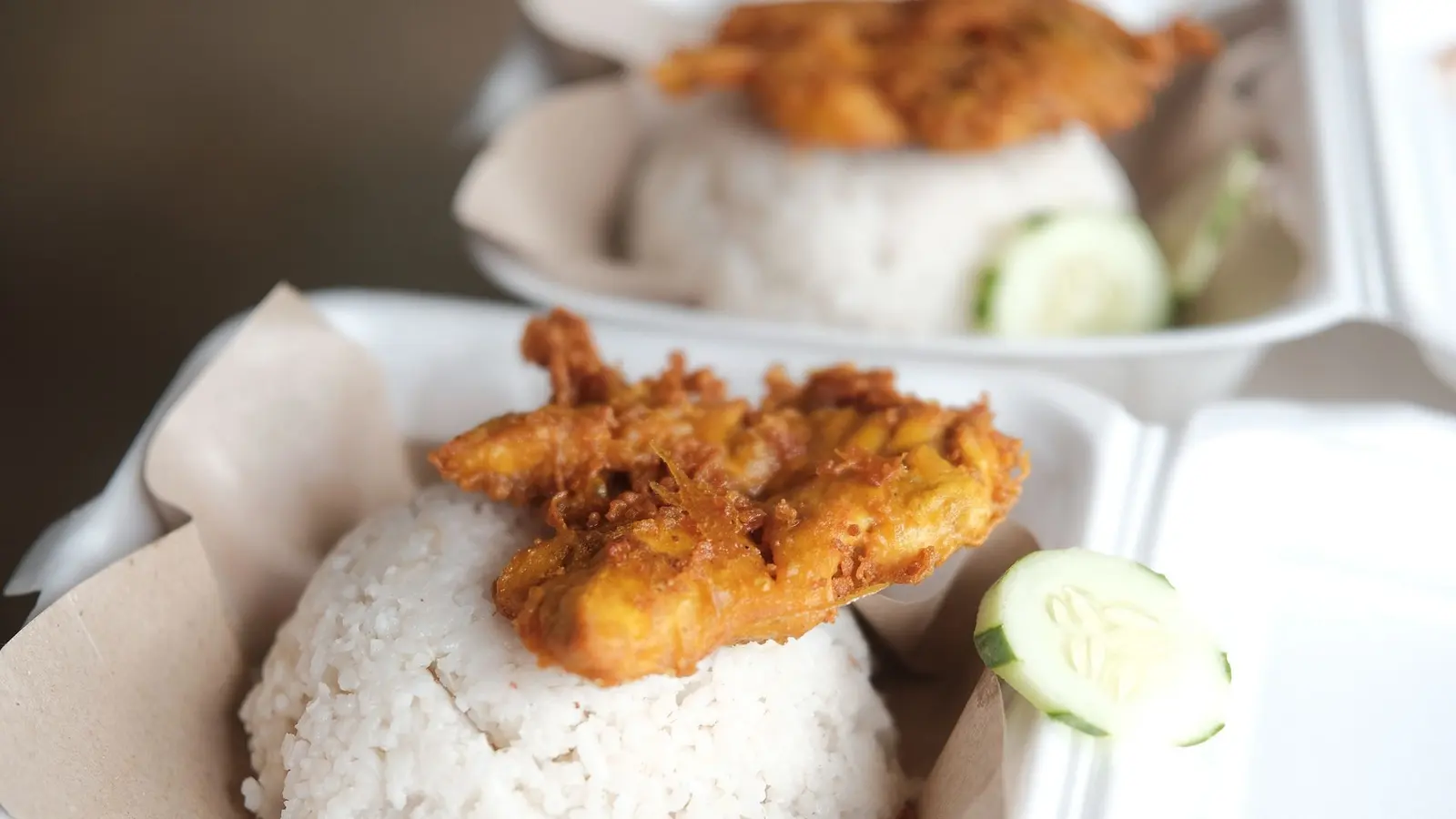
Ayam penyet means "smashed chicken" in Indonesian. Chicken pieces are first simmered in a turmeric spice paste, then fried until crisp. Each piece is pressed flat with a pestle, which loosens the meat, and it comes with a hot sambal, fried tempeh, fried tofu, raw cucumber and a mound of white rice. The dish comes from East Java in Indonesia.
In Singapore, ayam penyet is one of the most familiar Indonesian meals. You find it in mall food courts, at chains and at small halal restaurants in Geylang Serai and Orchard. It is easy to make at home because every ingredient is a normal item at NTUC FairPrice, Sheng Siong or a wet market stall.
Ingredients
For the chicken
- 4 chicken whole legs (about 1 kg), or 8 bone-in thighs and drumsticks
- 6 shallots, peeled
- 5 cloves garlic, peeled
- 3 cm fresh turmeric, peeled, or 1.5 tsp ground turmeric
- 3 cm galangal, sliced
- 2 candlenuts (buah keras), or 4 macadamia nuts
- 1 tsp ground coriander
- 2 stalks lemongrass, bruised and knotted
- 3 kaffir lime leaves (daun limau purut)
- 2 tsp salt
- 1 tsp sugar
- 700 ml water
- Vegetable oil for deep frying (about 750 ml)
For the sambal
- 8 large red chillies, deseeded if you want it milder
- 5 to 10 chilli padi, to taste
- 5 shallots, peeled
- 3 cloves garlic, peeled
- 1 medium tomato, quartered
- 10 g belacan (shrimp paste)
- 1 tbsp chopped gula melaka (palm sugar), or soft brown sugar
- 0.5 tsp salt
- 3 tbsp vegetable oil
- Juice of 2 limau kasturi (calamansi), or half a lime
For the sides
- 250 g tempeh, cut into 1 cm slices
- 2 pieces taukwa (firm tofu, about 300 g), cut into quarters
- 1 Japanese cucumber, sliced
- A few leaves of cabbage or lettuce
- 4 portions cooked white rice (from about 320 g uncooked rice)
- Salt and a pinch of ground turmeric for the tempeh and tofu
Method
- Blend the shallots, garlic, turmeric, galangal, candlenuts and ground coriander with 3 tbsp of the water into a smooth paste.
- Put the chicken, spice paste, lemongrass, lime leaves, salt, sugar and the rest of the water into a wide pot.
- Bring to a boil over high heat, then lower to medium and simmer uncovered for 30 to 35 minutes, turning the chicken twice, until the liquid has nearly dried up and the paste coats the meat.
- Lift out the chicken, scrape off any loose paste, and let it cool and dry on a rack for 10 minutes.
- While the chicken cools, toast the belacan in a dry pan over low heat for 2 minutes per side, until it smells strong and crumbles.
- Fry the red chillies, chilli padi, shallots, garlic and tomato in 3 tbsp oil over medium heat for 5 to 6 minutes, until soft and lightly blistered.
- Pound or blend the fried chilli mix with the toasted belacan, gula melaka and salt into a coarse paste. Stir in the calamansi juice and taste for salt and sugar.
- Rub the tempeh and taukwa with a little salt and turmeric.
- Heat the frying oil in a wok over medium-high heat to about 175°C (a wooden chopstick fizzes steadily when dipped in).
- Fry the tempeh for 3 to 4 minutes until golden, then drain on paper towels.
- Fry the taukwa for 5 to 6 minutes, turning once, until the skin is golden and firm, then drain.
- Fry the chicken in two batches for 5 to 7 minutes per batch, turning once, until deep brown and crisp. Drain well.
- Spread a spoonful of sambal in a stone mortar (cobek) or on a sturdy plate. Lay a piece of chicken on top and press it firmly with a pestle or the bottom of a heavy bowl until it flattens and the meat cracks.
- Serve each portion with rice, a piece of tempeh and tofu, cucumber, cabbage and extra sambal on the side.
Tips
- Make ahead: simmer the chicken a day early and keep it covered in the fridge, then fry it just before eating. It also crisps better when it is cold and dry.
- The sambal keeps for up to a week in a clean jar in the fridge, topped with a thin layer of oil.
- Pat the chicken dry before frying. Wet chicken spits hard in hot oil.
- Press the chicken, don't pound it to shreds. You want it flat with the meat loosened, not pulled apart.
- Toast belacan with the windows open or the hood fan on. The smell is strong and lingers.
- If you can't find fresh turmeric or galangal, use ground turmeric and 1 tsp galangal powder. Both are sold in the spice aisle of most supermarkets.
Where to eat it in Singapore
- D'Penyetz Heritage (KADA Maxwell), 5 Kadayanallur Street #01-06, behind Maxwell Food Centre. Its website says the chain started in Singapore in 2009. Other outlets include JEM, Tampines Hub and PLQ Parkside.
- Dapur Penyet, Jewel Changi Airport, 78 Airport Boulevard #B2-241. This is useful if you are arriving or flying out. The brand says it is MUIS halal-certified.
- Dapur Penyet, The Centrepoint, 176 Orchard Road #01-59, for a meal in the Orchard shopping belt. Other outlets include Funan, Tiong Bahru Plaza and City Plaza on Geylang Road.
Check opening hours on the brands' websites before you go.
The story
Ayam penyet is generally described as an East Javanese dish, and the best-known style is linked with Surabaya, the capital of East Java. It spread through Indonesia and on to Malaysia, Brunei and Singapore. In Singapore it grew in popularity during the 2000s as Indonesian chains opened here. Dapur Penyet says its story started in 2005, and D'Penyetz says it was founded in Singapore in 2009. Accounts of exactly who first made the dish do not agree, so treat any single origin story with care.