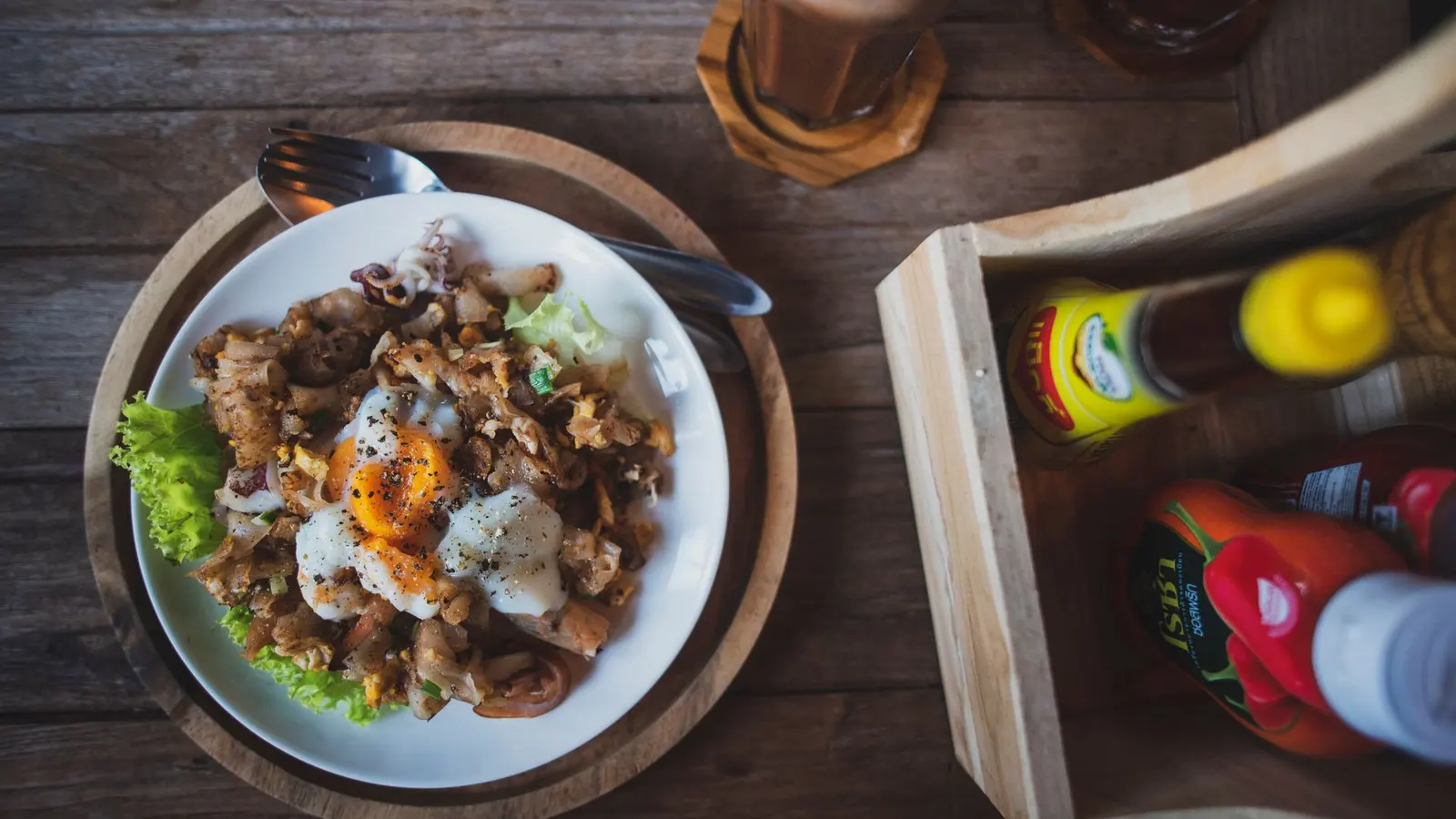
Wat tan hor is a plate of wide, flat rice noodles (hor fun) seared in a very hot wok until lightly charred, then covered with a thick, glossy gravy that has ribbons of soft egg running through it. Prawns, squid or fish slices and a few stalks of greens cook in the gravy. The name means smooth egg hor fun in Cantonese.
In Singapore you will find it at zi char stalls and hawker centres, often alongside beef or sliced fish hor fun. The smoky edge on the noodles from a fierce wok fire and the soft egg in the gravy are what people look for. This version is written for a home stove and uses ingredients sold at NTUC FairPrice, Sheng Siong, Cold Storage or any wet market.
Ingredients
For the noodles
- 800 g fresh flat rice noodles (hor fun or kway teow), from the chiller section or a wet market noodle stall
- 2 tbsp cooking oil
- 1 tbsp dark soy sauce
- 1 tsp light soy sauce
For the gravy
- 200 g medium prawns, peeled and deveined
- 150 g squid, cleaned and cut into rings (or the same weight of batang or snapper fillet, sliced)
- 150 g choy sum or kailan, cut into 5 cm lengths
- 4 cloves garlic, chopped
- 2 tbsp cooking oil
- 1 tbsp Shaoxing wine (optional; leave out for an alcohol-free dish)
- 800 ml chicken stock (homemade, or low-sodium stock from a carton)
- 2 tbsp oyster sauce
- 1 tbsp light soy sauce
- 1 tsp sugar
- 1/2 tsp ground white pepper
- 4 tbsp cornflour mixed with 6 tbsp cold water (tapioca starch works too)
- 3 large eggs, lightly beaten
- 1 tsp sesame oil
To serve
- Pickled green chillies or sliced red chillies in light soy sauce
Substitutes
- No fresh hor fun: soak 400 g dried flat rice sticks in warm water for 20 minutes, drain well, then use as below.
- No seafood: use 300 g sliced chicken thigh or pork, marinated for 10 minutes in 1 tsp light soy sauce and 1 tsp cornflour.
- No Shaoxing wine: use 1 tbsp chicken stock instead.
Method
- Gently pull apart the fresh noodles into single strands with your fingers. If they are stiff from the fridge, microwave them in their bag for 30 to 40 seconds first so they loosen without breaking.
- Mix the cornflour and water in a small bowl and set it next to the stove.
- Heat a wok or large frying pan on the highest heat for 1 to 2 minutes, until it just starts to smoke.
- Add 1 tbsp oil, then half the noodles. Spread them out and leave them alone for 40 to 60 seconds so they char in spots.
- Add half the dark and light soy sauce, toss for 30 seconds, then tip onto two serving plates. Repeat with the rest of the oil, noodles and soy sauce, and divide among four plates.
- Wipe the wok, return it to high heat and add 2 tbsp oil. Fry the garlic for 20 to 30 seconds until fragrant but not brown.
- Add the prawns and squid and stir-fry for 1 minute, until the prawns just turn pink.
- Splash in the Shaoxing wine, if using, and let it sizzle for a few seconds.
- Pour in the stock, then add the oyster sauce, light soy sauce, sugar and white pepper. Bring to a boil on high heat.
- Add the greens, stems first, and cook for 1 minute.
- Stir the cornflour mix again, then pour it in slowly while stirring. Cook for 1 minute on medium heat until the gravy turns thick and glossy.
- Turn the heat down to low. Pour in the beaten eggs in a thin stream in a circle around the wok. Wait 15 seconds, then push the egg gently across the wok once or twice so it forms soft ribbons.
- Turn off the heat and stir in the sesame oil.
- Ladle the gravy over the noodles straight away and serve with the chillies.
Tips
- Fry the noodles in two batches. A crowded wok steams them instead of charring them, and they turn soft and pale.
- Keep the heat low when the eggs go in. If the gravy is boiling hard, the eggs turn into hard, grainy bits instead of silky ribbons.
- Make the gravy slightly thicker than you think it needs to be, because the noodles loosen it as they sit.
- You can prepare the seafood, greens and cornflour mix up to 4 hours ahead and keep them covered in the fridge.
- This dish is best eaten as soon as it is made. Leftovers keep in a covered container in the fridge for up to 1 day. Reheat the gravy gently in a pan with a splash of water, and reheat the noodles separately.
- Fresh hor fun goes sour quickly. Check the expiry date on the pack and use it within a day or two of buying.
Where to eat it in Singapore
These stalls are known for wok-fried hor fun with gravy or egg. Check what is on the menu when you order, because not all of them sell a dish called wat tan hor.
- Wok Hei Hor Fun, Redhill Food Centre, 85 Redhill Lane, #01-94, Singapore 150085. Open 4pm to 8pm, Monday to Friday; closed on weekends. The beef hor fun is fried with egg, and there is also a sliced fish version, around SGD 6 a plate. Seth Lui's review calls it a newly named Michelin Bib Gourmand stall.
- Hin Fried Hor Fun, Ghim Moh Market and Food Centre, 20 Ghim Moh Road, #01-56, Singapore 270020. Open 10am to 3pm and 5pm to 8.30pm Wednesday to Saturday, and 10am to 3pm on Sunday; closed Monday and Tuesday. Smoky hor fun with beef or sliced fish in gravy, about SGD 6.
- Poh Preserved Veg Hor Fun, Chinatown Complex Food Centre, 335 Smith Street, #02-011, Singapore 050335. Open 11am to 7pm on Wednesday, Thursday, Saturday and Sunday, and 11am to 5.30pm on Friday; closed Monday and Tuesday. Run by a former hotel chef, it serves hor fun with preserved radish, egg and prawns from SGD 6.50.
Opening hours are from reviews updated in 2026. Hawker stalls often close for holidays, so check before you make a special trip.
The story
Singapore's Chinese dialect groups brought their own cooking with them when they arrived in the 19th century. According to the National Heritage Board's Roots page on Chinese cuisine in Singapore, Cantonese cooking comes from Guangdong and relies on techniques such as stir-frying, steaming and braising. An article in the National Library Board's BiblioAsia describes wok hei, the breath of the wok, as a core Cantonese technique: food is cooked fast over very high heat to give it a smoky flavour. That technique is what gives a good plate of hor fun its charred edge. The same article notes how Cantonese hawkers shaped several dishes now seen as Singaporean, a reminder of how much of the island's hawker food began in dialect kitchens and changed here over time.