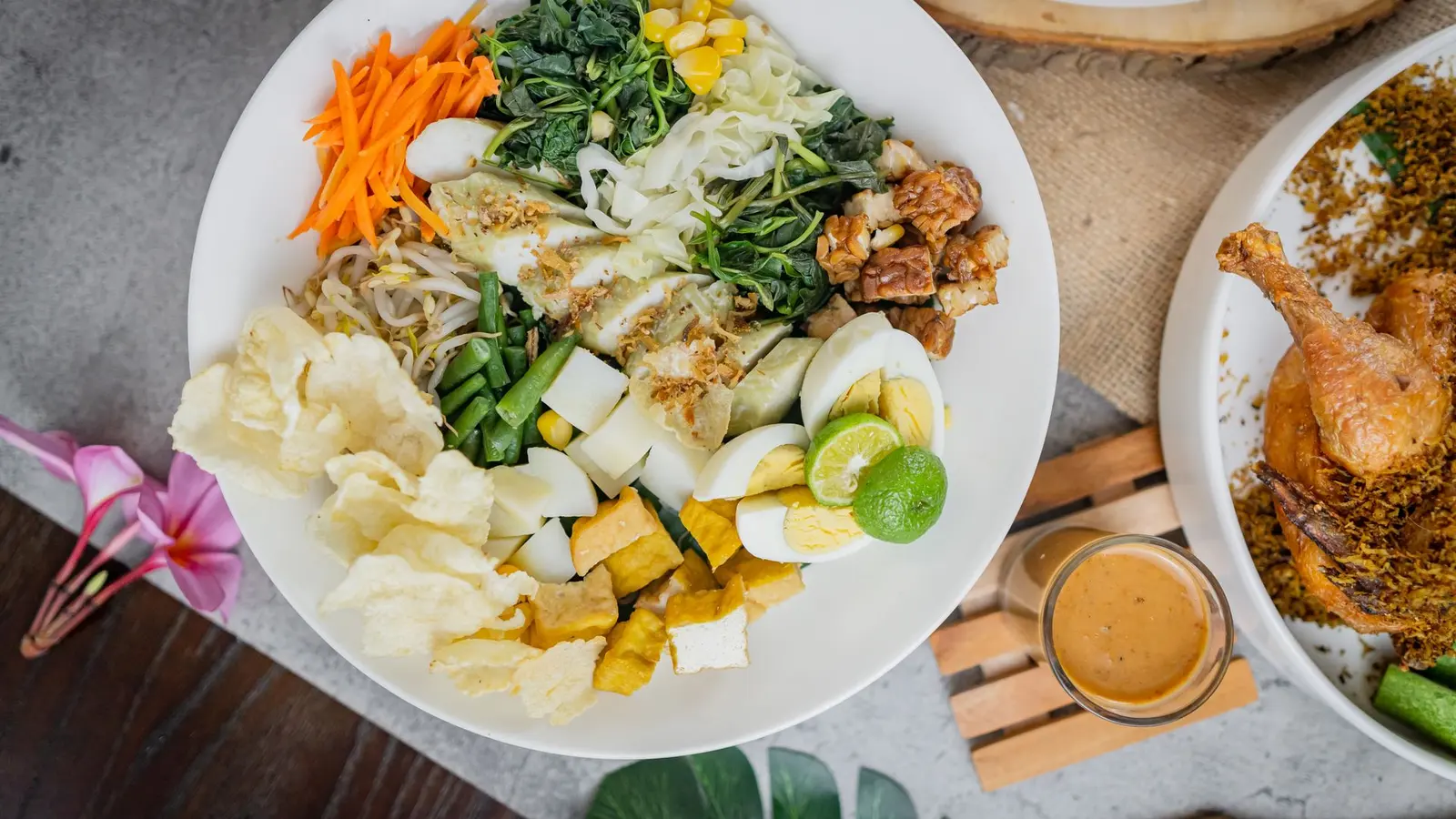
Gado-gado is a mixed salad of cooked and raw vegetables, fried tofu, potato and hard-boiled egg, finished with a thick peanut sauce. It comes from Indonesia. Here you find it at Malay and Indonesian stalls and restaurants, often next to mee rebus, mee soto and soto ayam. Singapore's Speak Mandarin Campaign lists it in its database of local terms with the Chinese name 马来豆腐沙拉, "Malay tofu salad", which shows how much the tofu matters in the local version.
This version works in a Singapore kitchen. Tau kwa, kangkong, long beans and bean sprouts are cheap and fresh at any wet market. Gula melaka, tamarind and belacan are on the shelves at NTUC FairPrice, Sheng Siong and Giant. The sauce takes most of the work, and it keeps well for a second round.
Ingredients
For the peanut sauce
- 200 g raw shelled peanuts, skin on or off (or 200 g unsalted roasted peanuts, and skip the frying)
- 3 tbsp cooking oil
- 4 shallots, peeled and sliced
- 3 cloves garlic, peeled
- 4 dried chillies, soaked in hot water for 10 minutes and deseeded (or 2 fresh red chillies)
- 1 tsp belacan (shrimp paste), optional; leave it out to make the dish vegetarian
- 1 tbsp tamarind pulp mixed with 60 ml warm water, then strained
- 40 g gula melaka (palm sugar), chopped (or 3 tbsp dark brown sugar)
- 1 tbsp kecap manis (sweet soy sauce)
- 200 ml coconut milk
- 200 to 300 ml water
- 1/2 tsp salt, plus more to taste
- 1 lime, juiced
For the salad
- 4 eggs
- 400 g waxy potatoes, such as Holland potatoes
- 2 pieces firm tau kwa (about 300 g)
- 200 g tempeh, optional
- Oil for shallow-frying
- 150 g long beans, cut into 4 cm lengths
- 200 g cabbage, cut into bite-sized pieces
- 200 g kangkong, leaves and tender stems only
- 150 g bean sprouts, tails picked if you have time
- 1 Japanese cucumber, sliced
To serve
- Prawn crackers (keropok) or emping (melinjo crackers)
- 3 tbsp ready-made fried shallots
- Lontong or ketupat (compressed rice cakes), optional; Malay stalls and some supermarkets sell them ready-made
Method
- Heat 3 tbsp oil in a wok over medium-low heat. Fry the raw peanuts, stirring all the time, for 6 to 8 minutes until golden. Lift them out onto a plate and let them cool for 10 minutes. Leave the oil in the wok.
- Grind the cooled peanuts in a blender or food processor until coarse, like breadcrumbs. Tip them into a bowl.
- Blend the shallots, garlic, chillies and belacan with 2 tbsp water into a rough paste.
- Reheat the oil in the wok over medium heat. Fry the paste for 4 to 5 minutes, stirring, until it darkens slightly and smells sweet.
- Add the ground peanuts, tamarind water, gula melaka, kecap manis, coconut milk, 200 ml water and the salt. Stir well.
- Bring it to a gentle simmer over low heat and cook for 10 to 12 minutes, stirring often so the bottom does not catch. Add more water a splash at a time if it gets thicker than pouring cream.
- Take the sauce off the heat and stir in the lime juice. Taste it and adjust with more salt, sugar or lime. It should taste sweet, salty, sour and a little spicy all at once.
- While the sauce simmers, put the potatoes in a pot of cold salted water. Bring them to the boil and cook for 15 to 20 minutes, until a knife slides in. Drain, cool, peel and cut them into thick slices.
- Lower the eggs into a pot of boiling water and cook for 9 minutes. Cool them in cold water, peel and halve.
- Pat the tau kwa and tempeh dry and cut them into 2 cm thick slices. Shallow-fry in 1 cm of oil over medium-high heat for 3 to 4 minutes per side, until golden and crisp. Drain on paper towels, then cut into cubes.
- Bring a large pot of salted water to a rolling boil. Blanch the vegetables one at a time and lift each batch out with a slotted spoon: long beans for 2 minutes, cabbage for 1 minute, kangkong for 30 seconds, bean sprouts for 20 seconds.
- Spread the blanched vegetables on a tray, or rinse them under cold water, so they stop cooking and stay green. Drain well.
- Arrange the vegetables, cucumber, potato, tofu, tempeh, eggs and rice cakes, if using, on four plates.
- Warm the sauce if it has cooled and pour it generously over each plate. Top with fried shallots and crush a few crackers over the top. Serve straight away, with more crackers on the side.
Tips
- Shortcut sauce: blend 200 g crunchy natural peanut butter (no added sugar) with the fried paste, the tamarind, sugar, kecap manis and coconut milk. Simmer for 5 minutes.
- Make ahead: the sauce keeps for 4 days in a covered container in the fridge, or 1 month in the freezer. It sets firm when cold, so loosen it with hot water as you reheat it.
- Do not overcook the greens: kangkong and bean sprouts go limp within seconds. Blanch them last and briefly.
- Dry the tofu well before frying. Wet tau kwa spits in the oil and will not crisp.
- Add crackers at the table. On a plate of sauce they go soft within minutes.
- Storage: keep leftover vegetables, tofu and sauce in separate containers in the fridge and eat them within 2 days.
Where to eat it in Singapore
- Wedang, Golden Mile Food Centre, 505 Beach Road, #B1-19. A small Malay stall where gado-gado is one of only a handful of dishes, at about S$5. It is open Tuesday to Saturday and closed on Sunday and Monday.
- Warong H.J. Sukarjo, The Marketplace @ 58, 58 New Upper Changi Road, #01-183, Bedok. Gado-gado is S$4. The stall opens only Friday to Sunday, from 9.15am to 2.30pm, so go early.
- The Coconut Club, outlets on Beach Road, in Siglap and at New Bahru. A sit-down Malay restaurant better known for nasi lemak. Its current menu lists a gado-gado salad at S$16, with fried tofu, long beans, cabbage, egg and belinjau crackers.
Stall hours change often, and hawker centres close for cleaning a few times a year. Check before you make a special trip.
The story
Gado-gado comes from Indonesia, where it is a well-known specialty. It spread from there across Southeast Asia, Singapore included. Singapore's Speak Mandarin Campaign database explains that the Indonesian name means to mix and stir, which matches the way the dish is assembled. It also names the peanut sauce, mixed in at the end, as the key to the dish. Indonesia's official tourism site calls the Betawi version a classic Jakarta dish and describes it as a single plate that brings the city's diversity together.