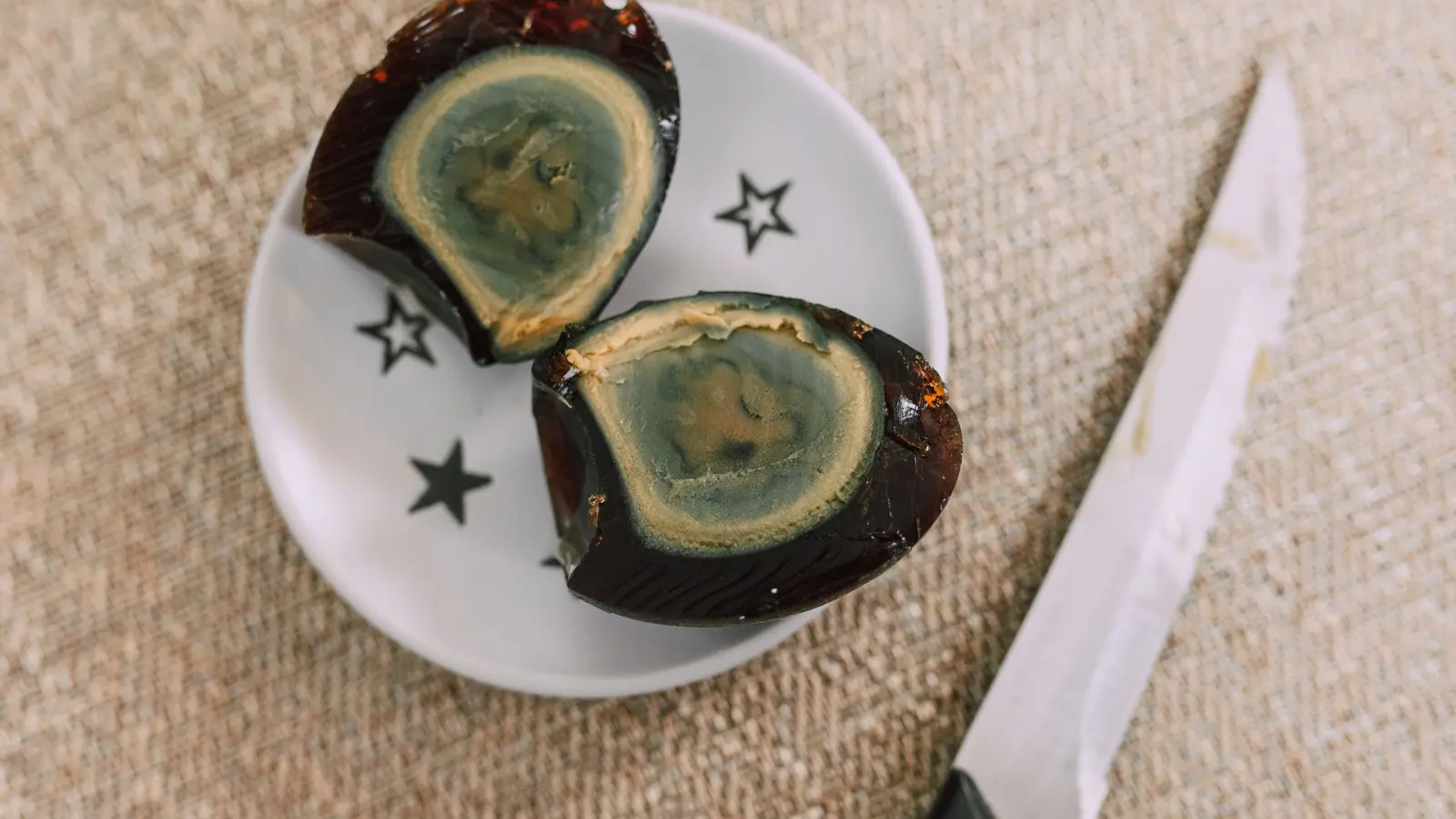
Cantonese congee is rice cooked in plenty of water until the grains break down into a silky, creamy porridge. Century egg is a preserved duck egg with a dark amber white and a soft, savoury yolk. Diced into the pot, it gives the congee a deep, slightly earthy richness. Tender pork balls, fresh ginger and spring onion finish the bowl.
In Singapore this is everyday hawker food, eaten at breakfast or as a light meal. It is not the same as Teochew porridge, which is thin and watery with whole grains. Cantonese congee is thick and smooth, and many people eat it with a fried dough stick (you char kway) torn into the bowl, plus a dash of white pepper and a few drops of sesame oil.
Ingredients
For the rice
- 150 g jasmine rice (Thai fragrant rice)
- 1 tsp salt
- 1 tbsp neutral oil (peanut or vegetable)
- 2.5 litres water
- 3 slices ginger, about 3 mm thick
- 1 tbsp dried scallops, rinsed (optional; use 1 chicken stock cube in their place)
For the pork balls
- 300 g minced pork, not too lean
- 1 tbsp light soy sauce
- 1 tsp oyster sauce
- 1/2 tsp sesame oil
- 1/4 tsp ground white pepper
- 1 tsp cornflour
- 2 tbsp cold water
For the century eggs
- 2 century eggs (pidan); a salted duck egg is a good substitute if you prefer a milder taste
To serve
- 2 spring onions, thinly sliced
- 1 thumb-sized piece ginger, cut into fine strips
- 1 or 2 fried dough sticks (you char kway), cut into short pieces
- Light soy sauce, sesame oil and ground white pepper, to taste
- Fried shallots (optional)
Method
- Rinse the rice twice in cold water and drain it well.
- Mix the drained rice with the salt and oil and leave it for 30 minutes. This helps the grains break down faster.
- Meanwhile, mix the minced pork with the soy sauce, oyster sauce, sesame oil, white pepper, cornflour and cold water. Stir hard in one direction for 2 minutes until sticky, then chill it until needed.
- Peel the century eggs, rinse them, and cut each one into 8 to 10 small pieces.
- Bring the 2.5 litres of water to a rolling boil over high heat in a large, heavy pot.
- Add the rice, the ginger slices, the dried scallops (or stock cube) and half of the century egg pieces. Stir well.
- Return to the boil, then lower the heat to medium-low so the pot bubbles steadily. Set the lid slightly ajar.
- Cook for 60 to 75 minutes, stirring the bottom of the pot every 10 minutes so the rice does not stick. Stir more often near the end as the congee thickens.
- When the grains have almost vanished and the congee coats a spoon, whisk it hard for 1 minute to make it smoother. If it is too thick, add hot water a little at a time.
- Shape the pork mixture into small balls with two teaspoons, or pinch off small pieces, and drop them into the simmering congee.
- Add the rest of the century egg and simmer on medium-low for 5 to 6 minutes, until the pork is cooked through.
- Taste, and add salt or light soy sauce if needed. Take out the ginger slices.
- Ladle into bowls and top with spring onion, ginger strips, fried dough stick, a pinch of white pepper and a few drops of sesame oil.
Tips
- Shortcut: rinse and drain the rice, freeze it overnight in a bag, and cook it from frozen. The ice breaks the grains and cuts cooking time by about a third.
- Use a heavy pot and keep stirring the bottom. Burnt rice at the base will taste through the whole batch.
- Congee keeps for up to 2 days in a covered container in the fridge. It sets firm when cold, so reheat it slowly with a splash of water and stir often.
- Add the pork balls only near the end. If they boil for too long they turn hard.
- Century egg has a strong smell when first opened. Rinsing it and leaving it in the air for a few minutes softens the smell.
- Buy fried dough sticks on the day you serve them, and crisp them for 3 to 4 minutes in an oven or air fryer at 180°C.
Where to eat it in Singapore
- Zhen Zhen Porridge, Maxwell Food Centre, 1 Kadayanallur Street, #01-54, Singapore 069184. A Cantonese-style congee stall whose best-known bowl has sliced fish, shredded chicken and century egg. It opens early and sells out, and listings give different opening days, so go in the morning and expect it to be shut on some weekdays.
- Chai Chee Pork Porridge, Fengshan Food Centre, 85 Bedok North Road, #01-23, Singapore 470085. Traditional Cantonese congee with pork and century egg, served into the late evening. Listed as closed on Mondays.
- Mui Kee, a Hong Kong congee house run by Les Amis Group, with branches at Shaw Centre (1 Scotts Road, #03-09, Singapore 228208) and Raffles City Shopping Centre (252 North Bridge Road, #B1-46, Singapore 179103). Opening hours for each branch are on the restaurant's website.
The story
Cantonese migrants from Guangdong were among the first Chinese dialect groups to settle in Singapore, from the 19th century. Many worked on plantations, on the docks and in trade, with help from their clan associations. They brought their food with them, and the National Heritage Board's Roots lists congee alongside dim sum as part of Cantonese restaurant fare here. The Singapore Chinese Cultural Centre's Culturepaedia says the first congee hawkers bought their rice from specialist rice shops that no longer exist. Most cooks now use Thai jasmine rice that has been stored for a few months, which cooks down into the smooth, creamy texture that marks the Cantonese style apart from Teochew porridge.