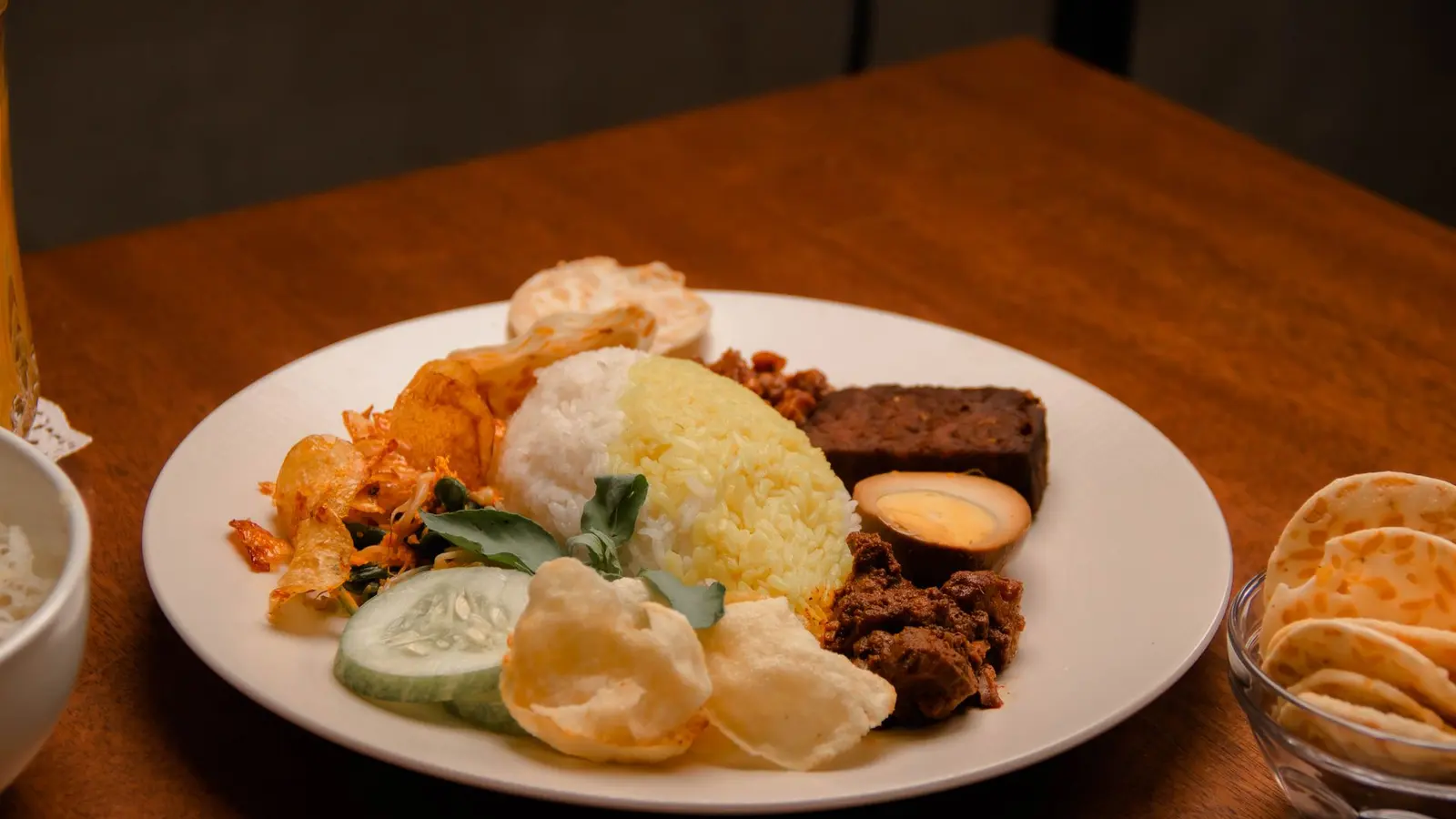
Beef rendang is beef simmered for hours in coconut milk and a chilli and herb paste. You keep cooking until the liquid is gone and the meat starts to fry in the oil it gives off. The finished dish is dark, dry and sticky, not soupy. Kerisik, which is grated coconut toasted and pounded into an oily paste, gives it a nutty depth and helps thicken the sauce.
The dish comes from the Minangkabau people of West Sumatra. In Singapore it is a regular at nasi padang stalls, where you choose your dishes from a counter to eat with rice. Kampong Gelam in particular has long been home to Minang families and their eateries. This recipe is for a home kitchen and gives substitutes for anything you might struggle to find.
Ingredients
For the spice paste
- 15 g dried red chillies (about 15), seeds shaken out, soaked in hot water for 20 minutes
- 4 fresh red chillies, roughly chopped
- 150 g shallots (about 10), peeled
- 5 cloves garlic
- 30 g galangal (lengkuas), sliced
- 20 g ginger, sliced
- 20 g fresh turmeric, peeled and sliced (or 1 tsp ground turmeric)
- 3 stalks lemongrass, bottom white part only, sliced
- 60 ml water, to help blending
For the curry
- 1 kg beef shin or chuck, cut into 4 cm cubes
- 4 tbsp cooking oil
- 1 cinnamon stick, about 5 cm
- 2 star anise
- 4 cloves
- 4 cardamom pods, lightly crushed
- 2 stalks lemongrass, bruised with the back of a knife and tied in a knot
- 6 kaffir lime leaves (daun limau purut), torn
- 1 turmeric leaf (daun kunyit), knotted (optional, see substitutes)
- 400 ml coconut milk
- 300 ml water
- 2 tbsp tamarind pulp mixed with 100 ml warm water, strained
- 20 g palm sugar (gula Melaka), chopped, or 1 tbsp brown sugar
- 1.5 tsp salt, plus more to taste
For the kerisik
- 80 g fresh grated white coconut (no brown skin), or 50 g unsweetened desiccated coconut
Substitutes
- Fresh grated coconut: wet market coconut stalls grate it to order. Desiccated coconut from a supermarket baking shelf works for kerisik. Ready-made kerisik in jars or packs is also sold in some shops; use 3 tbsp.
- Turmeric leaf: hard to find outside wet markets. Leave it out and add 2 extra lime leaves.
- Galangal: if you cannot find it, use 20 g extra ginger. The flavour will be less sharp.
- Fresh turmeric: 1 tsp ground turmeric.
- Kaffir lime leaves: the zest of 1 lime, added in the last 30 minutes.
- Beef shin: chuck or brisket also hold up to long cooking. Avoid lean cuts like sirloin, which turn dry and stringy.
Method
- Make the kerisik. Put the grated coconut in a dry wok over medium-low heat. Stir constantly for 12 to 15 minutes until it turns an even golden brown. Do not let it burn.
- Tip the hot coconut into a mortar or a small blender and pound or blend for 2 to 3 minutes until it clumps and looks oily. Set aside.
- Drain the soaked dried chillies. Blend them with all the other spice paste ingredients and the 60 ml water until smooth, about 2 minutes.
- Heat the oil in a heavy pot or wok over medium heat. Add the cinnamon, star anise, cloves and cardamom and fry for 1 minute until fragrant.
- Add the spice paste. Fry over medium-low heat, stirring often, for 15 to 20 minutes, until it darkens, smells sweet rather than raw, and oil separates at the edges.
- Add the beef and stir for 3 to 4 minutes to coat every piece in the paste.
- Pour in the coconut milk, the water and the strained tamarind liquid. Add the knotted lemongrass, lime leaves, turmeric leaf, palm sugar and salt. Stir well.
- Bring to a boil over high heat, then turn down to low. Simmer uncovered for 1 hour, stirring every 10 to 15 minutes.
- Stir in the kerisik. Keep simmering on low for another 1 hour to 1 hour 30 minutes, stirring every 10 minutes and scraping the bottom, until the sauce has reduced to a thick coating.
- Once most of the liquid is gone, stir every 2 to 3 minutes for the last 20 to 30 minutes. The oil will separate and the meat will start to fry and turn dark brown. Stop when the beef is tender and the sauce clings to it.
- Taste and adjust with salt or a little more sugar. Remove the lemongrass knot and whole spices if you like. Rest for 15 minutes before serving with steamed rice or ketupat.
Tips
- Rendang tastes better the next day. Make it a day ahead, cool it fully and reheat gently in a pan with a splash of water.
- Keep leftovers in an airtight container in the fridge for up to 4 days, or freeze in portions for up to 2 months.
- The paste must be fried until properly cooked. If it still smells raw when you add the beef, the finished curry will taste harsh.
- The last stage burns easily. Lower the heat and stay at the stove once the sauce gets thick.
- Too dry before the beef is tender? Add 100 ml water at a time and keep cooking.
- Want it wetter? Stop cooking at step 9 for a softer, saucier style.
- Heat level depends on the chillies. Use fewer dried chillies for a milder rendang and keep the fresh ones for colour.
Where to eat it in Singapore
- Rumah Makan Minang, 18 and 18A Kandahar Street, Kampong Gelam. A halal Minangkabau restaurant that names nasi padang and beef rendang as its specialities. Its own website lists daily hours of 7.30am to 6.30pm and a second outlet at Our Tampines Hub. It is on the National Heritage Board's SG Heritage Business Registry.
- Hjh Maimunah, 11 Jalan Pisang, near Kampong Gelam. A Malay and nasi padang restaurant whose official site lists beef rendang on its signature menu. Its locations page gives Jalan Pisang hours as 7.30am to 7pm Monday to Saturday (closed Sunday), with another restaurant at 20 Joo Chiat Road and smaller outlets in malls across the island.
Hours change, so check the restaurant's own page before you go.
The story
Rumah Makan Minang, one of Kampong Gelam's best-known nasi padang eateries, traces its start to 1954, according to the National Heritage Board's Roots portal. Hajjah Rosemah began by cooking Minangkabau food in the shophouse room her family rented, and Arab and Indonesian traders would walk through the living room to eat at a long table in her kitchen. Over the years she softened recipes such as asam pedas to suit local tastes, but her grandson Hazmi Zin, who runs the business today, says the rendang is still cooked the original Minangkabau way. Roots notes that Minang, Javanese and Boyanese families have lived in Kampong Gelam since the early 19th century, and that the area had three popular nasi padang eateries: Sabar Menanti, Rumah Makan Minang and Pariaman. The National Heritage Board describes the restaurant as now in its third generation, with signature rendang and sambal.