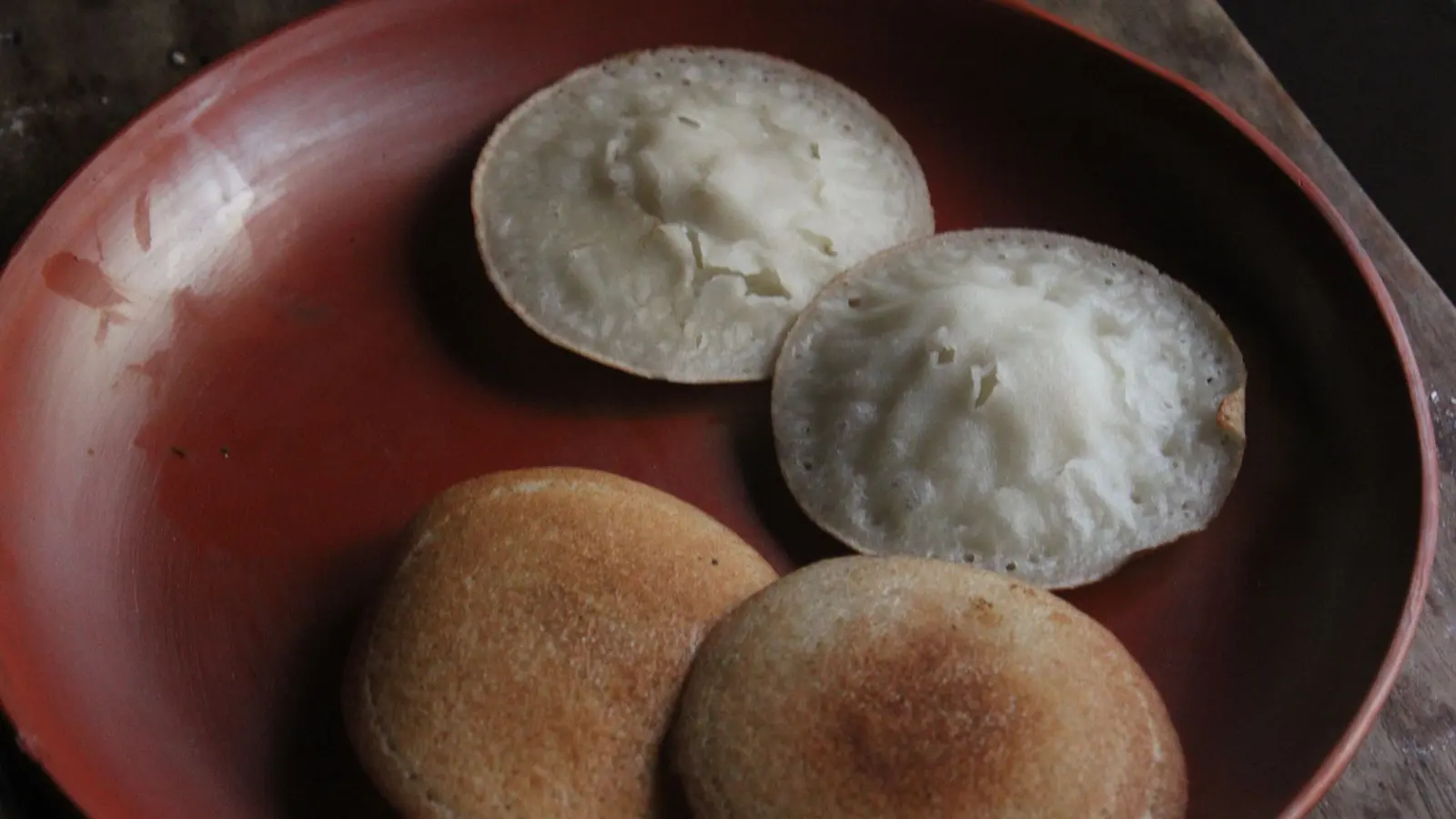
Appam is a bowl-shaped pancake made from a fermented batter of rice and coconut milk. It is thin and crisp around the rim and thick and spongy in the middle. The dish comes from South India, Kerala in particular, and from Sri Lanka, where it is called a hopper.
In Singapore you find appam at Indian stalls in hawker centres, usually served in pairs for breakfast. Stalls serve it plain with sweetened coconut milk, or with egg, butter, cheese, brown sugar or banana. The recipe below uses rice flour and a little cooked rice, so you need no grinder, and every ingredient is easy to find in Singapore.
Ingredients
Makes about 12 appam.
For the batter
- 250 g fine rice flour (the plain kind sold in supermarkets, not glutinous rice flour)
- 100 g cooked white rice, cooled (leftover rice works well)
- 1 tsp instant dry yeast
- 2 tbsp white sugar
- 300 ml lukewarm water
- 200 ml coconut milk (fresh from a wet market coconut stall, or a carton or can from the supermarket)
- 1/2 tsp fine salt
- 1/4 tsp baking soda (optional, for a softer centre)
- A little cooking oil for the pan
For the sweet coconut milk (to serve)
- 200 ml coconut milk
- 2 tbsp sugar, or 30 g gula melaka (palm sugar), grated
- 1 pinch salt
Equipment
- An appam pan (appachatti), a small round pan with a deep curve and a lid. If you don't have one, use a small non-stick wok, about 20 cm across, that has a lid.
Method
- Put the rice flour, cooked rice, yeast, sugar and 300 ml lukewarm water in a blender. Blend on high for 1 to 2 minutes until completely smooth, with no grains left.
- Pour the batter into a large bowl. It should fill no more than half the bowl, because it will rise.
- Cover the bowl and leave it on the kitchen counter for 6 to 8 hours, or overnight. In Singapore's heat it often ferments in 5 to 6 hours. It is ready when it has roughly doubled, has bubbles on top and smells slightly sour.
- Stir in 200 ml coconut milk and the salt. If you are using baking soda, add it now. Add water a spoonful at a time until the batter pours like thin cream, a little thinner than pancake batter.
- Rest the batter for 10 minutes while you heat the pan.
- Heat the appam pan or small wok over medium heat for 2 minutes. Wipe it with a little oil on a paper towel.
- Pour in one ladle of batter, about 60 ml.
- Straight away, lift the pan by its handles and turn it in a full circle so the batter coats the sides in a thin layer. Most of the batter should pool in the centre.
- Put the pan back on the heat, cover it with the lid and cook over medium-low heat for 2 to 3 minutes.
- The appam is done when the centre is set and no longer wet, and the edges are golden and pull away from the pan. Do not flip it.
- Loosen the edge with a thin spatula and lift the appam out. Wipe the pan with oil again and repeat with the rest of the batter.
- For the sweet coconut milk, warm the coconut milk, sugar and salt in a small pot over low heat for 3 to 4 minutes, stirring until the sugar dissolves. Do not let it boil. Serve it in a small bowl next to the appam for dipping.
Tips
- Batter that fails to rise usually means the water was too hot and killed the yeast, or the yeast was old. The water should feel just warm on your wrist.
- Over-fermented batter gets very sour. In hot weather, check it after 5 hours. Once it is ready, keep it in the fridge to slow the fermentation down.
- Make ahead: fermented batter keeps for up to 2 days in a covered container in the fridge. Let it come to room temperature for 30 minutes before you cook.
- Cooked appam is best eaten straight from the pan. Leftovers go chewy, but you can reheat them, covered, in a pan over low heat for a minute.
- Egg appam: after swirling the batter, crack a small egg into the centre, then cover and cook until the white sets.
- Sweet versions: sprinkle grated gula melaka or brown sugar and some grated coconut into the centre as soon as you have swirled the batter.
- Savoury pairing: appam also goes well with vegetable stew or chicken curry.
- A pan that is too hot sets the batter before you can swirl it, and you get a thick, small appam. Bring the heat down a little and let the pan cool for a few seconds between pancakes.
Where to eat it in Singapore
- Rajarani Thosai, #01-33 Tampines Round Market & Food Centre, 137 Tampines Street 11. A breakfast stall selling thosai and appam, including plain, egg, butter, coconut and cheese. A food review from April 2026 lists its hours as 7am to 1.30pm, closed on Wednesdays. It is not halal-certified.
- Mr Appam, #01-99 Maxwell Food Centre, 1 Kadayanallur Street. Run by a Vietnamese hawker who took over an Indian food stall and taught herself appam. Flavours include original, pandan brown sugar coconut, banana, chocolate and an egg-and-cheese "Princess" appam. Reviews from 2022 list its hours as 8am to 8pm, closed on Tuesdays. It is not halal-certified. Check before you go, because these listings are a few years old.
The story
Appam is generally traced to the Malabar coast of South India, especially Kerala. Its earliest written mentions appear in old Tamil literature, and in the late 18th century a European missionary recorded Kerala's St Thomas Christians eating it at their feasts. The pancake also spread to Sri Lanka, where under British rule it got its English name, hopper. It reached Singapore with migrants from southern India and Sri Lanka. The National Heritage Board's history of hawker culture notes that Indian migrants arrived from the 1800s and that Indian hawkers became part of the island's street food scene. Appam stalls used to be more common in Singapore than they are now, so the stalls still making it fresh each morning are worth seeking out.