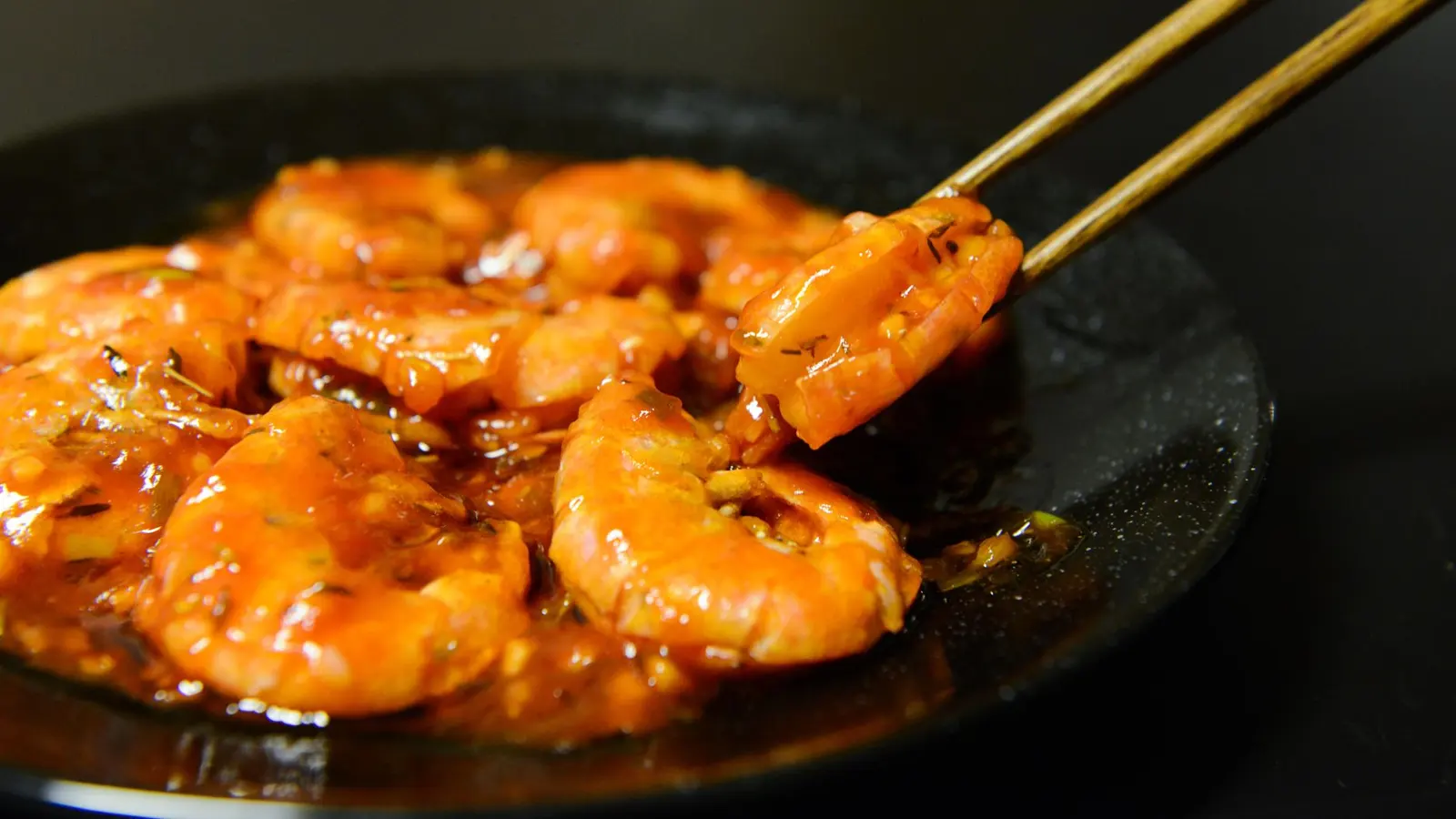
Salted egg yolk prawns are a zi char favourite in Singapore. Zi char is casual, home-style Chinese cooking for sharing. The prawns are dusted in cornflour and fried until crisp. Then they are tossed in butter and mashed salted duck egg yolk until the sauce foams up and clings to every shell. Curry leaves and chilli padi add fragrance and a bit of heat, and they keep the richness in check.
Salted duck eggs are an old Chinese pantry staple. Over the past 15 years Singapore has grown very fond of the flavour, and it now shows up on everything from croissants to crab. You can find this prawn version on seafood restaurant menus across the island, and it is easy to make at home in under an hour.
Ingredients
For the prawns
- 600 g medium to large prawns (about 16 to 20), shell on or peeled with tails left on
- 1/2 tsp salt
- 1/4 tsp ground white pepper
- 4 tbsp cornflour
- About 750 ml neutral oil for deep-frying (peanut, canola or sunflower)
For the salted egg sauce
- 4 salted duck eggs (sold raw in the egg section of supermarkets and at wet market egg stalls)
- 40 g unsalted butter
- 3 cloves garlic, finely chopped
- 2 sprigs curry leaves (about 20 leaves), stripped from the stem
- 2 to 3 chilli padi, sliced (use 1, or leave out, for less heat)
- 1 tsp sugar
- 2 tbsp evaporated milk or fresh milk (optional, for a creamier sauce)
Substitutes
- No raw salted eggs: use 4 ready-cooked salted egg yolks. Some supermarkets sell them vacuum-packed. Skip the steaming step and just mash them.
- No curry leaves: leave them out, or use a few Thai basil leaves added at the end. The taste will be different but still good.
- Prawns: frozen prawns work. Thaw them in the fridge overnight and pat them very dry.
Method
- Crack the salted eggs and separate them. Put the yolks on a heatproof plate and keep the whites for another dish (see Tips).
- Steam the yolks over high heat for 10 minutes, until firm and cooked through.
- While the yolks are still warm, mash them with a fork into a fine, sandy crumb. Set aside.
- Trim the prawn feelers and sharp tips with scissors. Cut along the back of each prawn and pull out the dark vein.
- Rinse the prawns and pat them completely dry with kitchen paper. Wet prawns spit in hot oil and won't crisp.
- Season the prawns with the salt and white pepper, then toss them in the cornflour until evenly coated. Shake off the excess.
- Heat the oil in a wok or deep pot over medium-high heat to about 180°C. A wooden chopstick dipped in the oil should send up steady bubbles.
- Fry the prawns in two or three batches for 1.5 to 2 minutes each, until pink and crisp. Drain on a rack or kitchen paper.
- Pour the oil out of the wok and wipe it clean. Turn the heat down to low.
- Melt the butter in the wok over low heat.
- Add the garlic, curry leaves and chilli padi. Stir for about 1 minute, until the leaves crackle and smell fragrant. Don't let the garlic brown.
- Add the mashed yolks. Stir continuously over low heat for 1 to 2 minutes, until the mixture bubbles and turns foamy.
- Stir in the sugar, plus the milk if using, and cook for 30 seconds more.
- Add the fried prawns and toss for about 30 seconds, until every prawn is coated. Turn off the heat.
- Serve straight away with steamed rice.
Tips
- Keep the heat low for the sauce. On high heat the yolk dries out, goes grainy and burns before it foams.
- Don't add salt to the sauce. The yolks are already salty. Taste first, and adjust only with sugar or a splash of milk.
- Make ahead: you can steam and mash the yolks up to 2 days ahead. Keep them covered in the fridge. Fry the prawns and make the sauce just before eating.
- Storage: leftovers keep in a covered container in the fridge for 1 day. The coating softens, so reheat in an oven or air fryer at 180°C for 4 to 5 minutes rather than in the microwave.
- Using the whites: salted egg whites are very salty. Stir a little into fried rice or a vegetable omelette in place of salt, or discard them.
- Crispier shells: shell-on prawns fried hot and fast stay crisp longer, and many people eat the thin shell along with the prawn.
Where to eat it in Singapore
- New Ubin Seafood, CHIJMES. 30 Victoria Street, #02-01B/C, Singapore 187996. Its May 2026 menu lists live tiger prawns, about 5 to 7 per 300 g portion, with salted egg as one of the cooking styles. The price is SGD 45 per 300 g, and a deshelled option is available. Open daily 11am to 1am, with last orders at 11.30pm.
- Red House Seafood, Esplanade. 8 Raffles Avenue, #01-14/16 Esplanade, Singapore 039802. Its à la carte menu lists Salted Egg Sauce Prawn (deshelled prawns), and you can also order crabs stir-fried in salted egg yolk sauce. Open daily including public holidays, for lunch from 12pm to 2.30pm and dinner from 5pm to 10pm. Last orders are at 2pm and 9.15pm.
Menus and prices change, so check with the restaurant before you go.
The story
Salted duck eggs are an ancient Chinese ingredient. The MICHELIN Guide notes that the earliest known written instructions for them appear in the Qimin Yaoshu, a Chinese farming text from the fifth century AD. That text says to soak duck eggs in brine for a month. Singapore's modern love affair with the flavour is much more recent. The Guide traces it to the liu sha bao, a steamed bun with a molten salted egg custard filling. The bun appeared in Hong Kong in 2009 and arrived in Singapore around 2011. A local ice-cream parlour had served salted egg ice cream as early as 2008, but the craze really took off in mid-2014. Restaurants and home cooks then began putting salted egg yolk on almost anything. Seafood favourites like these prawns are one of the most lasting results of that trend.