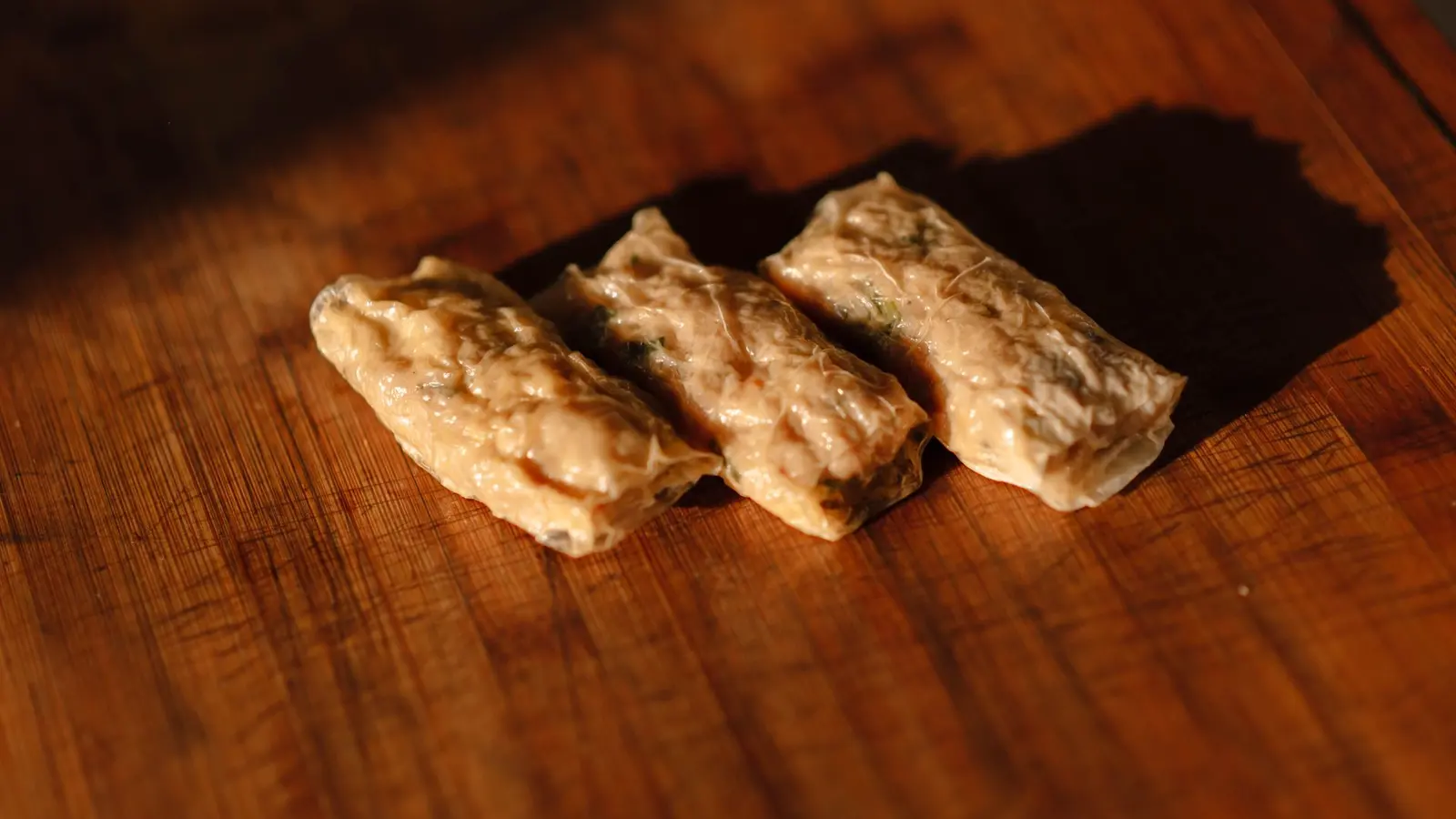
Ngoh hiang is a roll of minced pork and prawn seasoned with five-spice powder and wrapped in a thin sheet of dried beancurd skin. The roll is fried, cut into thick slices and eaten with a sweet dark sauce and chilli. The name is Hokkien for "five spice".
In Singapore you will usually find it at hawker stalls that sell fried snacks. These stalls set out trays of ngoh hiang beside prawn fritters, pork sausage, liver rolls and other fried items. You pick what you want and the stall fries it again so it comes to you hot. Some stalls lean towards the older Hokkien style and others serve a mix of Hokkien and Teochew items. At home the roll is a common dish for family gatherings and festive meals.
Ingredients
For the filling
- 400 g minced pork, with some fat in it (ask the butcher for about 20 percent fat)
- 200 g raw prawns, peeled, deveined and roughly chopped
- 6 fresh water chestnuts, peeled and finely diced (or 80 g bangkuang, also called jicama, finely diced)
- 3 shallots, finely chopped
- 2 spring onions, finely sliced
- 1 egg
- 1½ tsp five-spice powder
- 1 tbsp light soy sauce
- 1 tsp oyster sauce
- 1 tsp sesame oil
- 1 tsp sugar
- ½ tsp salt
- ½ tsp ground white pepper
- 2 tbsp cornflour
For wrapping and frying
- 2 large sheets dried beancurd skin (sold as beancurd sheet or fu pi in the dried goods section of supermarkets and at wet market dry goods stalls)
- 1 tbsp cornflour mixed with 2 tbsp water, to seal
- Cooking oil for shallow or deep frying (about 500 ml)
To serve
- Sweet sauce (tim cheong), from the sauce aisle or a hawker supply shop
- Bottled chilli sauce, or fresh chilli pounded with a little garlic, lime juice and salt
- Sliced cucumber
Method
- Put the pork, prawns, water chestnut, shallots and spring onions in a large bowl.
- Add the egg, five-spice powder, soy sauce, oyster sauce, sesame oil, sugar, salt, pepper and cornflour.
- Stir firmly in one direction for 3 to 4 minutes, until the mixture turns sticky and holds together.
- Cover and chill for 20 minutes so the filling firms up and is easier to roll.
- Wipe both sides of each beancurd sheet with a damp cloth. This softens the sheets and removes some of the salt. Cut each sheet into pieces about 20 cm by 25 cm, which should give 6 to 8 pieces.
- Lay one piece flat. Spoon about 80 g of filling along the long edge closest to you and shape it into a log about 3 cm thick.
- Fold in the sides, then roll it up firmly. Brush the far edge with the cornflour paste and press to seal. Repeat with the rest of the filling and sheets.
- Set up a steamer over boiling water. Steam the rolls on an oiled plate on high heat for 15 minutes, until the filling is firm and cooked through.
- Lift the rolls out and let them cool for at least 10 minutes. Pat them dry with kitchen paper.
- Heat the oil in a wok or deep pan over medium heat to about 170°C. A cube of bread should turn golden in about 30 seconds.
- Fry 2 or 3 rolls at a time for 4 to 5 minutes, turning now and then, until the skin is golden and crisp.
- Drain on a rack or kitchen paper for 2 minutes.
- Slice each roll on the diagonal into pieces about 2 cm thick. Serve hot with sweet sauce, chilli and cucumber.
Tips
- Make ahead: steam the rolls, cool them, then keep them covered in the fridge for up to 2 days. Fry them straight from the fridge, adding a minute to the frying time.
- Freeze: wrap steamed and cooled rolls one by one and freeze for up to 1 month. Thaw in the fridge overnight before frying.
- Leftovers: fried slices go soft in the fridge. Reheat them in an air fryer or a 200°C oven for 6 to 8 minutes instead of the microwave.
- Do not overfill. A thick roll may burst while steaming and takes longer to cook through.
- Torn skin: if a dry sheet cracks, wipe it again and wait a minute. A small tear can be patched with a scrap of skin and a little cornflour paste.
- Oil too hot: above about 180°C the skin darkens before the inside warms through. Keep the heat at medium.
- Prawn-free version: use 600 g pork in total, or swap the prawns for an equal weight of minced fish paste from the wet market.
Where to eat it in Singapore
The stalls below appear in a ngoh hiang guide last updated on 2026-03-31. Hawker hours change often, so check before you make a special trip.
- China Street Fritters, 61 Telok Blangah Heights, #01-121, Singapore 100061. This stall cooks Hokkien-style ngoh hiang. It traded at Maxwell Food Centre for years, then reopened in a Telok Blangah coffee shop in 2023.
- Lao Zhong Zhong Fine Spice Stall, 29 Tai Thong Crescent, Singapore 347858. A long-running stall in the Potong Pasir area.
- Seng Kee Ngo Hiang Prawn Cracker, Old Airport Road Food Centre, 51 Old Airport Road, #01-29, Singapore 390051. Open into the late evening.
- Old Airport Road Wu Xiang Xia Bing, 51 Old Airport Road, #01-56, Singapore 390051. In the same food centre, so you can try both stalls on one visit.
The story
Ngoh hiang has its roots in the Minnan region of southern China, where people speak Hokkien. The roll takes its name from five-spice powder, its main seasoning. Food writer Leslie Tay notes that when Hokkien migrants brought the stall tradition from Fujian, it began with five fried items: prawn fritters, pork rolls, pork liver rolls, egg rolls and pork sausage. In Singapore the pork roll came to share its name with the whole stall. Later stalls added more fried items, and Teochew cooks brought their own versions. Today you will find ngoh hiang in hawker centres across the island.