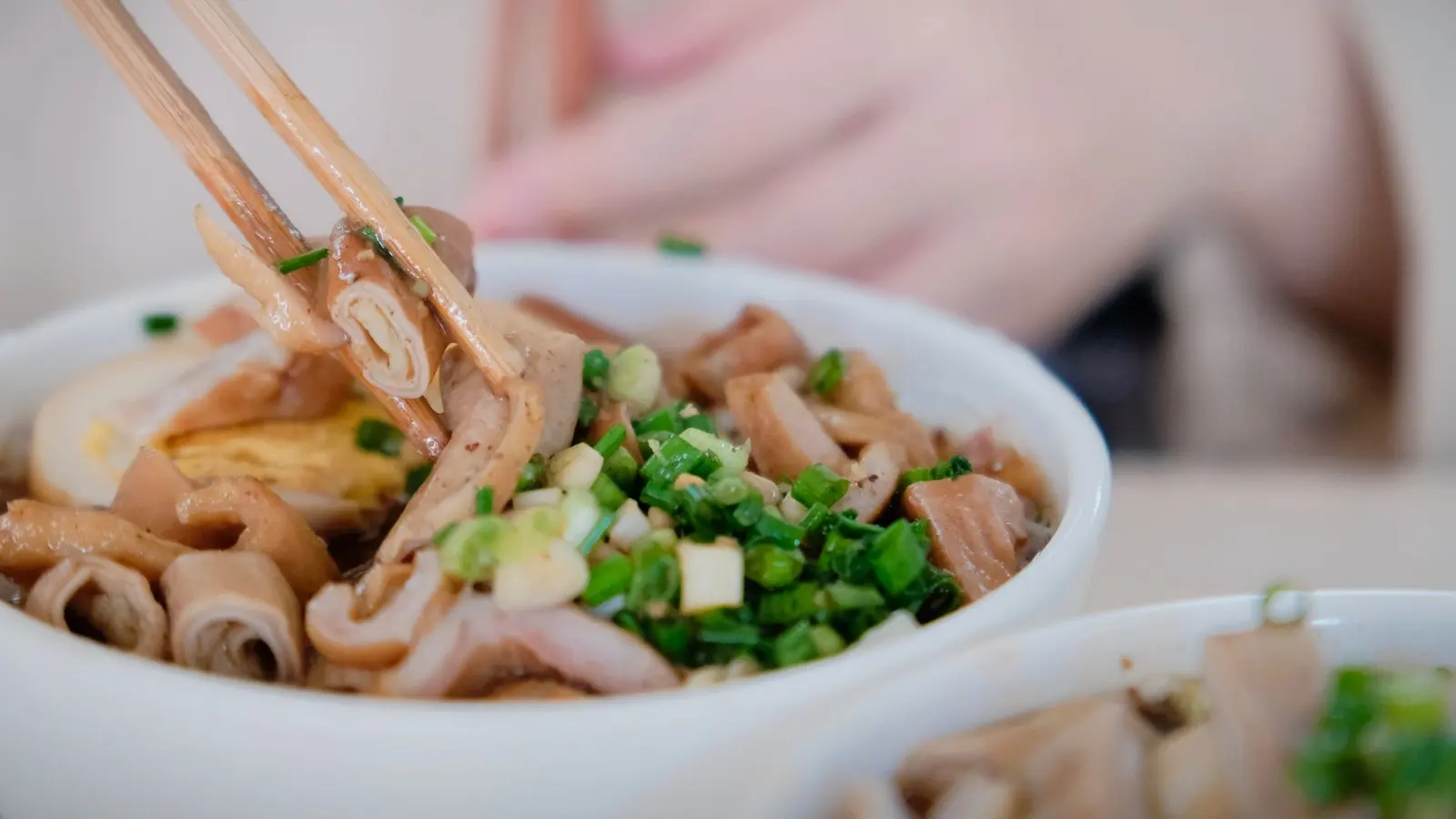
Lor mee is a Hokkien hawker noodle dish. Thick, flat yellow noodles go into a bowl and are covered with a dark gravy. The gravy is made from a spiced pork braise and thickened with starch and beaten egg. The toppings change from stall to stall. Common ones are braised pork belly, hard-boiled egg, fish cake, ngor hiang (five-spice meat rolls) and fried fish.
The gravy matters most. It should be thick enough to cling to the noodles, and you then add raw minced garlic, black vinegar and chilli at the table until it tastes right to you. Most hawker centres have a lor mee stall, and the dish is usually eaten for breakfast or lunch. This recipe makes a home version with ingredients from NTUC FairPrice, Sheng Siong or a wet market.
Ingredients
For the braise and gravy
- 400 g pork belly, in one piece
- 1.8 litres water
- 1 tbsp cooking oil
- 6 cloves garlic, smashed
- 3 slices ginger
- 2 star anise
- 1 small stick cinnamon (about 5 cm)
- 1 tsp five-spice powder
- 3 tbsp light soy sauce
- 2 tbsp dark soy sauce
- 1 tbsp oyster sauce
- 1 tbsp rock sugar or 2 tsp white sugar
- 1 chicken stock cube (or 1 tsp chicken stock powder)
- 6 tbsp tapioca starch or cornflour, mixed with 120 ml cold water
- 2 eggs, beaten
- Salt and white pepper, to taste
For the bowls
- 600 g fresh thick yellow noodles (sold as "yellow noodles" or "lor mee noodles" at supermarkets and wet market noodle stalls)
- 200 g bean sprouts, tails picked off if you like
- 4 hard-boiled eggs, halved
- 1 fish cake (about 150 g), sliced
- 1 ngor hiang roll (about 150 g), fried and sliced (optional)
- 150 g fried fish nuggets or fish balls (optional)
- A small bunch of coriander, chopped
For the table
- 1 whole bulb garlic, peeled and finely minced or grated
- Black vinegar (Chinese dark vinegar, such as Chinkiang)
- Sambal chilli or chopped fresh red chilli
Substitutes
- No fresh yellow noodles: use thick Hokkien noodles or frozen udon. Dried noodles are not a good swap here.
- No ngor hiang: leave it out and add more fish cake, or a few slices of braised pork.
- No tapioca starch: cornflour works the same way, though the gravy will be a little less glossy.
- No black vinegar: use rice vinegar with a few drops of dark soy. The flavour will be sharper and less rounded.
Method
- Put the pork belly in a pot of cold water and bring it to the boil over high heat. Boil for 3 minutes, drain and rinse off the scum.
- Heat the oil in a large pot over medium heat. Fry the smashed garlic, ginger, star anise and cinnamon for 1 minute, until fragrant.
- Add the five-spice powder and stir for 15 seconds.
- Add the pork belly, light soy, dark soy, oyster sauce and sugar. Turn the pork in the sauce for 2 minutes so it colours on all sides.
- Pour in the 1.8 litres of water and add the stock cube. Bring to the boil over high heat.
- Lower the heat, cover and simmer gently for 1 hour, until the pork is tender when you push a chopstick in.
- Lift out the pork and leave it to cool for 10 minutes, then slice it thinly.
- Strain the braising liquid into a clean pot and throw away the spices. You should have about 1.4 litres of liquid. Top it up with water if you have less.
- Taste the liquid and add salt and white pepper if it needs them. It should taste a little too salty at this stage, because the starch and noodles will tone it down.
- Bring the liquid back to a simmer over medium heat. Stir the starch mixture again, then pour it in slowly while you stir. Keep stirring for 2 to 3 minutes until the gravy turns glossy and thick enough to coat a spoon.
- Turn off the heat. Stir the gravy in a circle and pour in the beaten eggs in a thin stream, so they set into ribbons. Stop stirring after 10 seconds. Cover the pot to keep it hot.
- Bring a separate pot of water to a rolling boil. Blanch the bean sprouts for 20 seconds, lift them out and divide them between 4 bowls.
- Blanch the yellow noodles in the same water for 30 to 60 seconds, just until heated through. Drain them well and divide them between the bowls.
- Arrange the sliced pork, egg halves, fish cake, ngor hiang and fried fish on top.
- Ladle plenty of hot gravy over each bowl so the noodles are covered. Scatter over the coriander.
- Serve right away with the minced garlic, black vinegar and chilli on the table, so each person can season their own bowl.
Tips
- Start with a teaspoon of raw garlic and a teaspoon of vinegar, then add more. The gravy tastes flat without them, and they are what make lor mee taste like lor mee.
- Do not boil the gravy once the eggs are in, or the ribbons turn rubbery.
- If the gravy is too thin, mix 1 tbsp more starch with 2 tbsp cold water and stir it in over low heat. If it is too thick, loosen it with hot water.
- Starch-thickened gravy goes watery after a day in the fridge. To make ahead, braise the pork and keep the strained liquid in the fridge for up to 2 days, then thicken it just before you serve.
- Keep leftover noodles and gravy in separate containers. The noodles go soft if they sit in the gravy.
- Yellow noodles are made with alkali and can smell a little sharp. A quick rinse under hot water before blanching helps.
Where to eat it in Singapore
- Lor Mee 178, Tiong Bahru Market, #02-23, 30 Seng Poh Road. Listed in the MICHELIN Guide Singapore, which describes a rich gravy with fried fish nuggets, pork and bean sprouts. The listing shows it open 07:00 to 13:45 every day except Wednesday, when it is closed. Expect a queue at lunchtime.
- Feng Zhen Lor Mee, Taman Jurong Market & Food Centre, #03-146, 3 Yung Sheng Road. Listed in the MICHELIN Guide Singapore, which notes its generous toppings. The listing does not give opening hours, so check before you go.
The story
Lor mee (卤面) is a Hokkien term that means braised noodles. In its page on the dish, SG101, the Singapore Government's guide to national identity, describes lor mee as a popular hawker dish known for its thick, tasty gravy and springy, chewy noodles. It says the gravy is the part that counts most: it should be thick, never watery, and good enough to eat without any condiments. SG101 also notes that toppings depend on the stall and its style, from hard-boiled eggs and fish cake to fish flakes, ngor hiang and fried fish.